DOT Seeks New Rail Car Design and Bakken Crude Testing

Oil Rail Car Image
Oil Rail Car Image

The US Department of Transportation (DOT) proposed new rules this week for the testing of Bakken crude and better designed rail cars.

Within two years, the DOT proposes phasing out older DOT-111 tank cars for the shipment of packing group I flammable liquids. Unless the current DOT-111 and CPC-1232 tank cars are retrofitted to comply with new tank car design standards, they would not be approved for use in the transport of Bakken crude, which falls into the group I flammable liquids category.

In addition to the new tank car standards, new operating procedures like braking controls and speed restrictions for trains classified as high-hazard flammable trains were proposed. Also included in the DOT's recommendations, a new liquids and gas testing program to address the following:

  • frequency of sampling and testing;
  • sampling at various points along the supply chain;
  • sampling methods that ensure a representative sample of the entire mixture;
  • testing methods to enable better analysis, classification, and characterization of material;
  • statistical justification for sample frequencies; and,
  • duplicate samples for quality assurance.

PHMSA/FRA Report Finds Bakken Crude is More Volatile

In conjunction with the new proposed rules, the Pipeline and Hazardous Materials Safety Administration (PHMSA) released a report summarizing the analysis of Bakken crude oil data gathered by PHMSA and the Federal Railroad Administration (FRA) between August 2013 and May 2014.  According to the report, data show that crude oil from the Bakken region in North Dakota tends to be more volatile and flammable than other crude oils.

By contrast, in May of 2014, The American Fuel & Petrochemical Manufacturers (AFPM), an industry trade association, released findings from a study that examined the characteristics of Bakken crude oil. In their report, the AFPM claims Bakken crude is within the safety standards for current rail car designs (DOT 111 tank cars), and is comparable to other light crudes.

Read more: AFPM Study Finds Bakken Crude Meets Current Safety Standards for Rail Car Design

Read more at dot.gov

Lightning a Threat to Salt Water Disposal Tanks

Bakken Oil Well
Bakken Oil Well

As a result of Bakken development, a number of salt water disposal facilities have popped up throughout North Dakota and Montana.

Highly saline water or brine is a byproduct of the drilling process, and must be disposed of properly.

Lightning a Threat to Salt Water Disposal Tanks

At disposal facilities, brine and oil residue are stored in tanks, where the oil is skimmed off the top, and then brine is injected into the ground. This necessary practice has come under fire - literally - from lightning strikes. Since the Bakken boom began, lightning has been linked to the cause of multiple fires involving salt water disposal tanks, according to officials.

Salt water disposal tanks, which are generally constructed of fiberglass, are more prone to catching fire if struck by lightning. The reasons tanks catch fire experts say are because of the volatile gasses that collect in them from the oil residue mixed in with the brine and their fiberglass and other construction components.

What's the Solution?

The logical answer it seems would be to build the tanks out of more lightning resistant material, however, industry experts caution that isn't cost effective. For instance, steel tanks, which would be better suited to a lightning strike, are subject to the corrosive nature of the brine. Fiberglass tanks are much better suited to corrosion, and last longer.

Another more cost effective solution is to fortify the fiberglass tanks to make them resistant to lightning strikes. These fortifications are costly, but not nearly as costly compared to the damage caused by a direct hit from a lightning strike.

Despite the risk, some companies in the Bakken oil patch are willing to hedge their bets that a lightning strike will not hit their storage tank. But the simple truth is lightning wins the match every time when it hits a susceptible tank.

Read more on this subject at oilpatchdispatch.areavoices.com

North Dakota "Man-Rush"

Bakken Oil Workers
Bakken Oil Workers

The so-called "Man-Rush" is on in North Dakota, thanks to the development of the Bakken Shale formation.

Since the beginning of the boom in 2009, the number of men in North Dakota has jumped 14% (46,000), according to the U.S. Census Bureau. Overall, the state's population has grown 12% during the same time frame, but men have accounted for two-thirds of that growth. The population of women has grown as well, but only by 9% (30,000).

Most North Dakota Jobs in Oil & Gas Industry Held by Men

Most of the Jobs in North Dakota's burgeoning oil and gas industry are held by men. The primary reason for that is because much of the work involves hard manual labor jobs traditionally held by men (i.e. deckhand, roughneck, roustabout, pipe-fitter, etc.).

Loding Options Catered to Men

Some  Lodging options are even referred to as Man Camps, which are specifically designed to host large numbers of oilfield workers. Recently, Target Logistics, a Boston-based builder and operator of housing projects primarily for the energy industry, secured a 30-million contract to provide lodging for Bakken Shale oilfield workers over the next three years.

Read more: New Bakken Man Camp Coming Soon

To read more about the North Dakota "Man-Rush", and see how it compares to other booms, Click Here to view a study released by the Pew Research Center.

Whiting Petroleum Acquires Kodiak Oil & Gas - $3.8 Billion

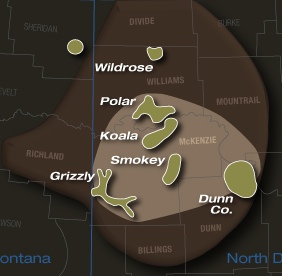
Whiting Bakken Acreage Map

Whiting Petroleum announced on July 13, 2014, that it would acquire Kodiak Oil & Gas, in an all stock transaction, for $3.8 billion. The deal makes the combined company the largest Bakken/Three Forks producer, unseating Harold Hamm's Continental Resources from the top spot.

Next to the Eagle Ford Shale in South Texas, the Bakken Shale is the most prolific shale play in the world, with daily oil production exceeding 1-million b/d. With Whiting's acquisition of Kodiak, the company is positioning itself to be an even more formidable force in the Bakken.

In the first-quarter of 2014, Whiting and Kodiak had combined production of 107,000 boe/d, and officials indicate total 2014 production will be 152,000 boe/d. The combined company has 855,000 net acres and an inventory of 3,460 net drilling locations.

The addition of Kodiak’s complementary acreage position (approx. 173,000 net acres) and substantial inventory of high return drilling locations will provide the opportunity to drive significant value growth for both Whiting and Kodiak shareholders through an acceleration in drilling and increase in operational efficiencies,” said Whiting CEO James Voulkner.
Kodiak Bakken Acreage Map

Whiting officials said the deal is valued at $6 billion when Kodiak's net debt of $2.2 billion is absorbed.

Kodiak shareholders will receive 0.177 share of Whiting stock in exchange for each of Kodiak common stock they hold, representing a value of $13.90 per share based on the closing price of Whiting shares on July 11, 2014.

The transaction is expected to close in the fourth quarter of 2014.

Read more at whiting.com

U.S. Leads World-Wide Oil Production

U.S. Oil Production
U.S. Oil Production

The U.S. is now the world's largest producer of oil, surpassing Russia and Saudi Arabia, according to Bank of America Corp. (BAC), as reported in Bloomberg.

U.S. crude oil output in the first quarter surpassed 11-million b/d, which was the highest volume produced by the country in 24 years. The U.S. is expected to hold the top spot through the end of the year, BAC officials said.

Most of that production is coming from North Dakota and Texas, which produced nearly half (48%) of all U.S. oil in April of 2014, according to the Energy Information Administration (EIA). Recently, the state of North Dakota hit the 1-million b/d mark for oil, nearly tripling its production over a three year period. The increase in production is directly related to the development of the Bakken Shale. Since April of 2011, production from the Bakken increased 19,000 b/d on average each month, according to the EIA.

Read more: North Dakota & Texas Make Up Half of U.S. Oil Production

According to the International Energy Agency (IEA), U.S. oil output will increase to 13.1 million b/d in 2019 and plateau. Most analysts agree the Bakken and Eagle Ford Shale plays, which are largely responsible for production in Texas and North Dakota, will peak around this time, and begin to decline.