
Baytex Energy May Sell Bakken Assets

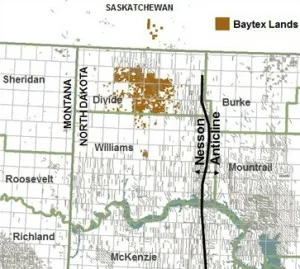
Baytex Energy Bakken Assets

Calgary-based Baytex Energy appears to be on the verge of divesting some of its assets, and the company's Bakken assets may soon be on the auction block.

Recently, Baytex added 22,200 net contiguous acres in South Texas' Eagle Ford Shale through its $2.8 billion acquisition of Aurora Oil & Gas, which closed in June of 2014. Baytex officials say the company conducted a portfolio review of assets late in the second quarter in response to the Eagle Ford acquisition. During that process certain assets were earmarked for divestment, which officials say would be used to pay down debt.

Read more: Baytex Energy - Aurora Deal for Eagle Ford Assets - ~$2.6 Billion

Baytex has not disclosed any official word as to which assets, if any, may be divested from its portfolio. However, the Bakken assets may be a good candidate considering they make up only ~4% of the company's current production. According to analyst commentary in a recent Bloomberg article, Baytex could generate $375 million from the sale of its Bakken assets.

At the end of 2013, the company commissioned contingent resource assessments for some of its assets, including the Bakken. The results revealed the Bakken had the lowest number of contingent resources compared to some of the company's other assets.

Baytex's Bakeen assets are located mostly in Divide County. By the end of 2014, the company plans to drill 15 (9.6 net) wells in the area.

Read more at baytexenergy.com

Russian Hackers Mount Attacks on Western Oil & Gas Industry

The newest threat to the oil & gas industry could be hiding on one of your favorite web pages! According to The New York Times, Russian hackers are using the web to gain access to the computer networks of hundreds of Western oil and gas companies to conduct industrial espionage. Attacks, which can come in the form of mass emails containing malicious links, are also hidden on web pages an employee views often. It's called a "watering hole attack." What happens is hackers infect a site with malicious software, and employees unknowingly download the malware when visiting the site, allowing hackers to gain access to the company's computer network.

According to Symantec, a cyber security firm based in the U.S., the attackers known as "Dragonfly" or "Energetic Bear" have been around since 2011, and exhibit the hallmarks of a state-sponsored operation. In one of their attacks, the hackers hit a number of industrial control system (ICS) equipment providers, infecting their software with a remote access-type Trojan. This gave the hackers the means to mount sabotage operations against infected ICS computers, and even though no such action was taken, it represents a very real threat. For now, the primary goal of the hackers appears to be industrial espionage.

Russia's Oil & Gas Industry

Russia's industrial espionage campaign on the West is providing the country with valuable intelligence to further exploit their resources. According to the U.S. Energy Information Administration (EIA), Russia is the second-largest producer of dry natural gas and third-largest liquid fuels producer in the world. Russia's economy is also highly dependent on its hydrocarbons, and oil and gas revenues, which account for more than 50% of the federal budget revenues.

Companies with operations in the Bakken Shale in North Dakota and the Eagle Ford Shale in South Texas could make excellent targets for Russian hackers. Over the past several years, technological advancements have abounded since development began in these plays began. It makes sense that the Russians would want to target these companies to gain access to privileged information.

What are your thoughts on this issue? Please share your comments below.

North Dakota & Texas Make Up Half of U.S. Oil Production

U.S. Oil Production
U.S. Oil Production

Combined production from North Dakota and Texas made up nearly half of U.S. oil production according to the Energy Information Administration (EIA) in April of 2013.

Recently, the state of North Dakota hit the 1-million b/d mark for oil, nearly tripling its production over a three year period. The increase in production is directly related to the development of the Bakken Shale. Since April of 2011, production from the Bakken increased 19,000 b/d on average each month, according to the EIA.

Read more: North Dakota Hits the 1-Million b/d Mark

In July of 2014, the EIA predicts the Bakken will produce nearly 1.1-million b/d of oil. June production was 1,074,000 b/d.

Bakken is Major Contributor to U.S. Oil Production Growth

The tight oil and shale gas revolution has changed the face of the energy industry in the U.S., and by 2015, the U.S. is predicted to be the top oil producer in the world, according to the International Energy Agency (IEA). As the country re-asserts itself as a world-wide oil producer, the state of North Dakota is expected to remain in a leading role for oil production.

Texas Leads the Way

The Eagle Ford Shale in South Texas is the only other shale play in the country that can top the Bakken for oil production. State-wide production in Texas was 3-million b/d in April of 2014 according to the EIA. Current production estimates place Texas above the second rated OPEC producing country of Iraq.

Enterprise Products Partners North Dakota Pipeline to Cushing

Bakken pipeline threatened
Pipeline Construction

Enterprise Products Partners tells a pipeline summit in North Dakota in late June of 2014 it plans to build a 1,200 mile oil pipeline from the Bakken to Cushing, Oklahoma, a major gathering and distribution hub.

The pipeline is planned to be 30 inches in diameter and would originate in Stanley, ND. Company officials said it will have a capacity of 340,000 bbls of oil and should be online by the end of 2016. The pipeline would be Enterprise's first in North Dakota.

The Pipeline Summit was hosted by North Dakota Gov. Jack Darlymple on June 24th at the National Energy Center of Excellence on the Bismarck State College Campus. This is the second such summit hosted by the governor since the Bakken oil boom began. Currently, 70% of all oil produced in North Dakota is transported by rail. Truck transport has also been used a primary means of transporting oil to pipeline/rail facilities, due to an overall lack of pipeline infrastructure in the state.

Enterprise Makes the Headlines for Oil Exporting

Enterprise also made the headlines in June when the Commerce Department’s Bureau of Industry and Security gave it and another company permission to export condensate from the Eagle Ford Shale play in South Texas to foreign buyers. The ruling marks the first time in forty years for exports of unrefined American oil, easing the oil export ban, which has been in place since the Arab oil embargo of the 1970s.

Read more: Oil Exporting Begins

The decision was handed down to the company in a private ruling from Commerce Department, according to the Wall Street Journal. The paper noted the private rulings by the Commerce Department define some ultra-light oil (i.e. condensate) as fuel after it has been minimally processed, making the oil eligible for sale outside of the U.S.  

With the door open to Enterprise to export condensate from the Eagle Ford, and domestic production reaching record levels in the U.S., exports of crude/condensate from the Bakken Shale could be on the horizon.

Oil Exporting Begins

ND Pump Jack Photo
ND Pump Jack Photo

After nearly four decades, the Obama administration has opened the door for U.S. exports of unrefined American oil, according to The Wall Street Journal (WSJ).

The decision, WSJ reported, was approved in a private ruling by the Commerce Department's Bureau of Industry and Security, and will for now allow only two companies, Pioneer Natural Resources Co. (NYSE: PXD) and Enterprise Product Partners LP (NYSE: EPD), to export condensate to foreign buyers. PXD and EPD said they sought permission to export processed condensate from South Texas' Eagle Ford Shale, the article noted.

Condensate, which is also referred to as ultra-light oil, and light sweet crude oil make up a majority of production in the Eagle Ford Shale and to a slightly lesser extent in the Bakken Shale. Next to the Ealge Ford, the Bakken Shale produces the most light sweet crude oil/condensate in the U.S. As a general rule, lighter crudes and condensate are easier to process into refined products.

The new rule flirts with current rules put into place after the Arab oil embargo in the 70s, which allow U.S. companies to export refined products such as gasoline, but not unrefined products (i.e. crude and condensate). WSJ reports the private rulings by the Commerce Department define some ultra-light oil as fuel after it has been minimally processed, making the oil eligible for sale outside of the U.S. With the door open to PXD and EPD to export condensate from the Eagle Ford, and domestic production reaching record levels in the U.S., exports of crude/condensate from the Bakken Shale could be on the horizon.

Continental Resources CEO Pushing for Lift of Export Ban

The Commerce Department's ruling is an encouraging sign for those who have been proponents of lifting the export ban. Harold Hamm, the CEO of Continental Resources, the Bakken's largest producer, testified in January of 2014, at a hearing of the Senate Energy and Natural Resources Committee, to ease the limitations the ban imposes. Hamm, who has been outspoken on the issue, says scarcity fears on which the law banning oil exports is based no longer exist.

Read more at wsj.com