McKenzie County Officials Push for Temporary Housing Permits

When the Bakken oil boom began, thousands of people moved to Williston, Watford City and other small communities near the epicenter of the boom in North Dakota to take advantage of high-paying oilfield jobs. However, after existing housing infrastructure quickly filled up in these areas, various points on the unregulated North Dakotan prairie became home to thousands as oilfield camps and other temporary housing started to pop up. With the highest concentration of drilling activity, McKenzie County, ND, faced a big problem: how was it going to keep track of all these people? The solution came when local officials passed ordinances requiring mancamps, temporary housing complexes for oilfield workers, and RV parks obtain permits and addresses. Despite seeming like a nuisance to some locals opposed to the ordinances, the new requirements proved to very helpful for local law enforcement when an EF-2 tornado destroyed an oilfield camp south of Watford City in late May of 2014. Ultimately, the new requirements helped emergency crews pinpoint the oilfield camp's exact location after the tornado struck.

Read more: Bakken Tornado Injures Nine in Watford City, ND - Video

With continued demand for workers in North Dakota, and no end to the Bakken boom in sight for the immediate future, the lack of permanent housing is likely to continue. The counties with the highest concentration of licensed recreational vehicle parks and campgrounds in the state are in McKenzie, Mountrail, and Williams. As of this writing, the current active rig count in these counties is 62, 32, and 31 respectively.

North Dakota Hits the 1-Million b/d Mark

Bakken Oil Production Forecast - NDPA

The State of North Dakota has surpassed the 1-million b/d oil mark according to the North Dakota Industrial Commission's (NDIC) Department of Mineral Resources (DMR), thanks mostly to the Bakken Shale and Three Forks formation.

The preliminary data, released in the monthly Director's Cut in June of 2014, revealed April oil production was 1,001,149 b/d. North Dakota is second only to Texas for oil production.

It's certain poor weather conditions at the end of 2013 and the beginning of this year prevented the production milestone from being hit sooner. According to North Dakota officials, in the month of February, there were 18 days with temperatures five or more degrees below normal. Four days were recorded where wind gusts were too high for completion work. Despite the poor weather, the state set a new record for the number of producing wells (10,186) in February. In April, North Dakota broke that record again, with 10,658 producing wells. By contrast, at the onset of the shale revolution in 2008, the state only had ~3,600 producing wells.

Read more: Bakken Production Sets Another Record for Producing Wells - Feb

The Bakken region, which includes portions of western Montana, exceeded the 1-million b/d mark at end of last year according to the Energy Information Administration (EIA). It is the fourth region, along with the Gulf of Mexico, Eagle Ford, and Permian basins, producing more than 1 million b/d in the nation.

In April of 2014, Continental Resources, the Bakken's largest producer, cited IHS data revealing the Bakken field of North Dakota and Montana reached another milestone of 1 billion bbls of cumulative light, sweet crude oil produced during first quarter of 2014. According to Continental officials, two-thirds of the oil has been produced since 2011.

Read more: Continental Resources: Bakken Hits 1-Billion Barrel Mark

Highlights from June 2014 Director's Cut

  • Mar Oil - 977,178
  • Apr Oil - 1,001,149 b/d
  • Mar Gas - 1,085,631 mcf/d
  • Apr Gas - 1,133,742 mcf/d
  • Mar Producing Wells - 10,472
  • Apr Producing Wells - 10,658
  • ND leasing activity is low consisting mostly of renewals and top leases in the Bakken - Three Forks area

How Bakken Crude Wellhead Valuation Influences Transport

Bakken Rig
Bakken Rig

Since 2012, Bakken crude transport by rail has grown significantly - today nearly 70% of all crude produced is transported to the consumer by rail.

Although pipeline transport is still critical in the Bakken, much of the movement has shifted to rail due to its overall cost effectiveness, and experts anticipate this growth to continue.

In response to this increase in rail transport, Platts, an energy news and price publisher, began offering its subscribers an assessment of value nearest the Bakken crude wellhead in late April of 2014. Platts Editorial Director Sharmilpar Kaur said in a written statement that crude transport by rail has influenced industry demand for crude value assessments closer to the wellhead.

Given the rapid growth in the transportation of crude oil by rail, the industry was in need of Bakken Shale oil value at North Dakota terminals with the operational capacity to move crude by rail or by rail/pipeline, said Kaur.

The service captures the value of Bakken crude at the point where there is transportation flexibility either by rail, or rail/pipeline. This assessment ultimately provides industry with greater intelligence before the decision is made on using truck, rail and/or pipeline to deliver the crude to customers.

Founder of BakkenShale.com and industry veteran Kenny DuBose, commented, “It is important to attempt to establish pricing points as close to the wellhead as possible, in order to separate and distinguish between the commodity value and any transportation expenses.

According to Platts, in 2016, more pipelines are expected to come online in the Bakken, which should ultimately offer industry more transportation flexibility in the region. The first Platts' Bakken price assessment was 91.93 per barrel on April 23, 2014.

NDIC Implements New Bakken Flaring Rule - June 1, 2014

North Dakota flaring

Beginning on June 1st, the North Dakota Industrial Commission (NDIC) began implementing its first in a series of policy changes aimed at reducing flaring in the Bakken.

The NDIC's new "gas capture plan" (GCP) rule will require E&P companies to submit a document with their application for a permit to the commission specifying how they plan to capture gas produced from their drilling operations.

In May of 2014, the North Dakota Pipeline Authority (NDPA) released production data for March of 2014, indicating 33 % of natural gas was flared in the state. With the new policies implemented, the NDIC hopes to capture 85% of natural gas produced in the state in the next two years, and at least 90% by 2020.

Since the boom began, flaring has conceivably prevented the state from collecting untold amounts of money in revenue from production. North Dakotan mineral owners, whom have also felt slighted, began filing class action lawsuits against oil companies in late 2013 for royalty payments lost due to flaring. Recently, in May of 2014, a federal judge dismissed 13 of 14 lawsuits filed against oil and gas operators. These among other reasons have been the impetus for NDIC's policy changes relative to flaring.

Read more: Mineral Owners Sue Over Bakken Flaring

Under the GCP, flaring is limited to one year after first production from the well. After that time frame elapses, the well must be connected to a gas gathering line or capped. The well can also be equipped with an electrical generator, or compression or liquefaction system that consumes at least 75% of the gas.

The new regulations are based on recommendations from the North Dakota Petroleum Council (NDPC). The NDPC is a trade association that represents more than 500 companies involved in all aspects of the oil and gas industry including oil and gas production, refining, pipeline, transportation, mineral leasing, consulting, legal work, and oilfield service activities in ND, SD and the Rocky Mountain Region.

Read more at dmr.nd.gov

Bakken Crude Pushed to West Coast Refining Markets

Bakken Crude Rail Costs

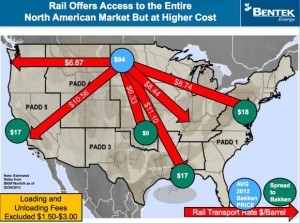
Bakken Crude could be pushed out of the Gulf Coast refining market as soon as this year or early next year. That prediction was revealed by Bentek Energy Sr. Analyst Erika Coombs at the annual Benposium Conference in early June of 2014.

Production growth in the Eagle Ford Shale and Permian Basin, and nearly completed pipeline and infrastructure projects for the Permian, will make Bakken crude transport to the Gulf Coast uncompetitive according to Coombs. As a result, oil production from the Bakken is expected to primarily target the West Coast refining markets in Washington and California. 

Although the destination for some Bakken crude volumes may be changing, how it will get there is not. Analysts at the conference said rail will remain the major source of transport for Bakken crude. Approximately 70% of Bakken crude arrives to market by rail.

Read more: Railroads Are Moving 70% of Bakken Oil Production

Currently, pipeline infrastructure in the Bakken is slim, but two new major oil pipelines have been proposed to serve the Williston, including the Double H Pipeline and the Sandpiper Pipeline. At the end of 2013, Enbridge Partners, the company that proposed the Sandpiper Pipeline, announced it reached an agreement with Marathon Petroleum to become an anchor shipper.

Read more: Enbridge's Sandpiper Pipeline Gains Anchor Shipper in Marathon Petroleum - Open Season

Highlights from Benposium 2014

  • Rail will remain the primary source of transportation in the Williston Basin
  • Bakken crude oil transport will shift from Gulf Coast refining market to West Coast
  • Bentek predicts the price of crude oil will dip to $82 by 2019
  • Bakken average drilling days down from 30 - 19 from 2011 - 13