

Is the Bakken America's Last Oil Boom?

EOG CEO Bill Thomas
EOG CEO Bill Thomas

At the Thirtieth Annual Sanford C. Bernstein Conference on May 29, 2014, EOG Resources CEO Bill Thomas indicated the company doesn't see another shale play of the same magnitude as the Bakken or Eagle Ford on the horizon.

According to Thomas, the Bakken and the Eagle Ford currently produce 75% of all horizontal oil production in the U.S., but he notes the two plays are beginning to mature, and their growth rates are beginning to slow.

Thomas said, “we don’t see another play out there that’s like an Eagle Ford or Bakken that will maintain this tremendous growth that we have had going forward. So production we believe is beginning to slow. In 2012, [production] was about 1-million b/d per year and then last year was a little over 800,000 b/d per year. We are looking at maybe this year 750, maybe in 2016 650,000 b/d per year and really over a fairly short period of time we really believe that the U.S. will be in kind of a very low growth mode. So oil is not going to just go on forever because there is not really another Eagle Ford or Bakken out there.

Thomas' postulation about the Bakken and Eagle Ford, which is likely an accurate depiction, doesn't diminish the impact these plays have already had, or will continue to have on the oil and gas industry, and the U.S. economy. According to the EIA, production in the Bakken Shale has now exceeded the 1-million b/d mark. Recently, Continental Resources, the Bakken Shale's largest producer, released data showing the Bakken field of North Dakota and Montana reached the milestone of 1-billion bbls of cumulative light, sweet crude oil produced during first quarter of 2014.

Read more: Continental Resources: Bakken Hits 1-Billion Barrel Mark
Bakken Tornado Injures Nine in Watford City, ND - Video

An EF-2 tornado destroyed 15 recreational vehicles at Raley RV Park, an oilfield camp south of Watford City, ND, on Monday, May 26th, 2014, according to officials. Nobody was killed; however, a 15-year old girl was transported to Trinity Hospital in Minot, ND, from injuries sustained during the storm. Eight other victims were treated and released according to the McKenzie County Sherrif's Department.

The CBS news video below includes an eyewitness account of man who lived in Raley RV Park:

Due to the Bakken oil boom, many oilfield workers are utilizing recreational vehicles as temporary housing. Tornadoes, which are notorious for laying waste to mobile home and RV parks, usually strike without warning; however, it's still important for residents of temporary camps to have a plan. Storm shelters offer the best chance for survival during a tornado; however, that option isn't feasible for most folks in the Bakken oil patch. The next best thing to do is scout out a permanent structure within a reasonable distance from your camp. Generally, anything with a concrete foundation is safer than a recreational vehicle during a tornado.

Oasis on Track to Achieve Bakken Production Targets for 2014

Oasis Production Chart

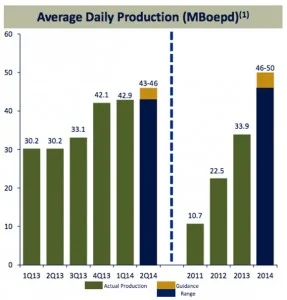
Oasis Petroleum is on track to reach the low end of its estimated 2014 daily production target of 46,000 boe/d in the second quarter of the year. Current production estimates for Oasis' second quarter production are between 43,000 boe/d - 46,000 boe/d.

During the first quarter of 2014, the company's total production was 42,856 boe/d. That figure represents production growth of approximately 5% quarter over quarter for the company.

To help achieve its production targets, Oasis will continue slickwater tests, after seeing a 25% production uplift in three of its core operating areas. Specifically, these areas are Indian Hills, Foreman Butte, and Red Bank. Oasis says it now intends to complete 20% of wells during the second half of 2014 with the slickwater technique.

Oasis CEO Thomas B. Nusz, said, “based on encouraging results to date from slickwater tests and other completion technology, we intend to complete over 60% of our wells in the second half of 2014 with alternative completion techniques. We are focused on designs that may increase production or reduce costs, ultimately driving higher per well and per drilling spacing unit returns.

During the first quarter, Oasis completed the sale of certain non-operated properties in its Sanish project area and other adjacent non-operated properties on March 5, 2014 for cash proceeds of $321.9 million. Properties ear-marked in the sale were 8,354 net acres and 28.2 net producing Bakken and Three Forks wells.  Production from the properties was 2,691 boe/d during Q4 2013.

Read more: Oasis Sells Bakken Acreage - Strong Production Growth in 2014

Also during the first quarter, the company picked up an additional rig, and anticipates a sixteenth rig after the spring. The company says a majority of its rigs will be operating on pads through the spring.

Hess Production To Soar in Bakken By the End of 2014

Hess' Bakken Acreage Map

Hess' first quarter 2014 Bakken production increased slightly from the fourth quarter, but company official say total Bakken production was curtailed due to the shutdown of the Tioga gas plant. Company officials now say Hess' Bakken production levels are greater than 80,000 boe/d after work was completed on the Tioga gas plant expansion.

The expansion project, which is part of a $1.5 billion investment Hess has made in the area for infrastructure improvements, is now fully operational, and the plant is currently processing about 120-million standard cubic feet of gas per day (MMSCFD). The company expects the plant will soon process at least 250 MMSCFD with the potential to increase beyond 300 MMSCFD.

Read more: Hess to Begin Selling Bakken Natural Gas from Tioga Plant

Hess' First Quarter 2014 Operations Update

Hess brought 30-operated wells online during the first quarter, with drilling and well completions averaging $7.5 million. The company's net Bakken production during the quarter averaged 63,000 boe/d, and net oil production was 58,000 b/d. Total capital expenditures in the Bakken for the quarter were $451-million. That's a 21% decrease from $571-million in the fourth-quarter.

Since 2010, Hess company officials say they have invested more than $10 billion in North Dakota. Currently, the oil giant has a 17 rig drilling program in the Bakken with 2014 net production expected to average 80,000 to 90,000 boe/d.

AFPM Study Finds Bakken Crude Meets Current Safety Standards for Rail Car Design

Oil Rail Car Image
Oil Rail Car Image

In May of 2014, The American Fuel & Petrochemical Manufacturers (AFPM) released findings from a study that examined the characteristics of Bakken crude oil and the standards required to transport by rail. In their report, the AFPM claims Bakken crude is within the safety standards for current rail car designs, and is comparable to other light crudes. In particular, the AFPM said the study found Bakken crudes are within the regulatory limits for pressure, flashpoint, boiling point and corrosivity for use in Department of Transportation (DOT) approved railcars.

This report was aimed at specifically addressing the characteristics of Bakken crude and concludes that its characteristics are no different than other light crude oils,” said AFPM President, Charles Drevna. “We believe this data will help better inform the government as it reviews all aspects of the safe transportation of crude by rail.

The study comes on the heels of a number of U.S. elected officials asking for more railway safety measures, following multiple train derailments and explosions involving Bakken crude. In early April of 2014, a Senate Appropriations Subcommittee hearing was held to examine the level of federal resources that should be allotted for railway safety.

Read moreU.S. Senators Appeal to Senate Appropriations Committee for Railway Safety Funding

Bakken Crude DOT Classification

Bakken crude oil is designated as a flammable liquid under the Hazardous Materials Regulations (HMR), and therefore is subject to evaluation of its flashpoint and initial boiling point for classification purposes. The study found while Bakken crude and other light crudes may contain higher amounts of dissolved flammable gases compared to some heavy crude oils, the percentage of dissolved gases would not cause Bakken crude to be transported under a DOT hazard class other than Class 3 Flammable Liquid. AFPM's conclusion for the study is there is no need to create a new DOT classification for crude oil transportation.