Magnum Hunter Resources Bakken First Quarter Update

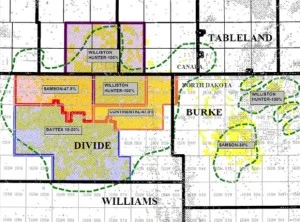
Magnum Hunter Bakken Shale Map

During the first quarter of 2014, Magnum Hunter Resources participated in the drilling of 4 gross (0.7 net) non-operated wells in the Bakken/Three Forks Sanish formations in North Dakota. At the end of the quarter, 4 gross (1.0 net) wells were drilling or waiting on fracture stimulation. Capital expenditures since the first of the year in the Bakken amounted to $11.6 million.

Across the company's portfolio, oil and gas production increased 102% for the quarter to 14,796 boe/d, compared to the same time period last year.

Magnum Hunter First Quarter Bakken Operations Update

Magnum Hunter Resources reported one operated one-mile lateral well was completed in the Middle Bakken formation, with an average initial production (IP) 24-hour rate of 223 boe/d at a 35% water cut. Four non-operated two-mile lateral wells were completed in the Middle Bakken formation, with an average IP 24-hour rate of 534 boe/d. One non-operated, three-mile lateral well, was completed in the Middle Bakken formation, with an average IP 24-hour rate of 949 Boe/d, and seven non-operated two-mile lateral wells were completed in the Three Forks Sanish formation with an average IP 24-hour rate of 544 boe/d.

Magnum Hunter Bakken Midstream Update

In May of 2014, Magnum Hunter revealed it will begin transporting oil from some of its non-operated wells in Divide County, North Dakota, through a third-party, to the Colt Hub in Epping, North Dakota. The company expects ~51 existing wells, combined with 18 wells scheduled under the 2014 drilling program, to be connected to the gathering system, which is slated to be fully operational by September 2014. A truck terminal will also be constructed and connected to the gathering system to minimize oil hauling costs from wells not connected to the gathering system.

Furthermore, ~125 gross wells have now been connected into the Oneok gas gathering system in North Dakota. The company estimates current net throughput volumes on this system at approximately 1,000 Mcf/d and 170 barrels of NGLs, or 340 boe/d.


Halcón Resources Sets New Operations Records in the Williston Basin

Halcon Bakken Acreage Map

During the first quarter of 2014, Halcón Resources (HK) set new company operations records in the Williston Basin for drilling and production.

A major focus for Halcón is on improving efficiencies, particularly those associated with pad drilling. Currently, Halcón is in the process of putting six new wells online in the Fort Berthold area that were drilled from a single pad and spaced 660' apart. The initial production (IP) rate for one of these wells during the quarter was a record breaking 4,225 boe/d. 

The company also recorded its fastest drilling times to date during the first-quarter. A Bakken well in the Fort Berthold area was drilled in 12 days (spud to total depth). Another Three Forks well in the Fort Berthold area was drilled in 17 days (spud to total depth).

Halcón Williston Basin First Quarter Operations Update

Halcón operated an average of four rigs in the Williston Basin during the first quarter, and the company plans to keep an average of three to four rigs active for the remainder of the year. Average production for the quarter was 23,313 boe/d. That's a 73% increase compared to the same period in 2013.

Weather-related issues slowed down drilling and completion that were begun late in the fourth quarter of 2013. Despite the weather-related impacts and delays, Halcon saw average initial and 30 day production rates improve during the quarter. Company officials say activity in the Williston Basin has since returned to normal, and current production is approximately 25,000 Boe/d.

Halcón Non-Operated Interests in the Williston Basin

Halcón participated in 72 non-operated wells during the quarter with an average working interest of approximately 6%. Current production from non-operated wells is approximately 3,500 boe/d.

By contrast, there are currently 144 Bakken wells producing, 11 Bakken wells being completed or waiting on completion and 2 Bakken wells being drilled on Halcón's operated acreage.

Similarly, there are currently 44 Three Forks wells producing, 5 Three Forks wells being completed or waiting on completion and 2 Three Forks wells being drilled on the Company's operated acreage.

Read more at halconresources.com

Lynchburg, VA Train Derailment Sparks Increased Scrutiny of Bakken Crude Oil

Oil Rail Car Image
Oil Rail Car Image

In late April of 2014, a train carrying Bakken crude derailed and burst into flames in Lynchburg, VA. No one was injured, but the incident has once again raised safety concerns about the transportation of crude by rail.

Currently, the U.S. Department of Transportation (DOT) Pipeline and Hazardous Materials Safety Administration (PHMSA) is conducting tests of Bakken crude. In February of 2014, PHMSA announced it would pursue fines against Hess, Marthon Oil, and Whiting for failing to properly classify their oil. PHMSA requires the use of nine hazardous materials classifications.

Read more: Hess, Marathon, and Whiting Face Fines for Bakken Oil Classifications

In a May 2014 Wall Street Journal Report, the publication cited the DOT's claim that most energy companies operating in the Bakken haven't provided the requested testing data on crude they ship by rail. Exxon Mobil Corp., Continental Resource and Savage Services Corp. have voluntarily provided the data. A statement released by the U.S. DOT suggested it may take steps to force companies to submit data.

Is Bakken Crude More Flammable?

Bakken oil is produced at a high quality that makes it easier to refine into commercial products and makes it easier to ignite. Light oil production growth in the Bakken isn’t something the industry has never handled before, but the Bakken boom is bigger than anyone expected. As a result of lack of pipelines and additional infrastructure, nearly 70% of all Bakken crude is transported by rail.

Read moreIs Bakken Oil More Flammable?

History of Bakken Crude Oil Train Derailments and Explosions

The incident in Lynchburg, VA is the most recent in a chain of train derailments and explosions connected to Bakken crude. In July 2013, a train derailed and exploded in LacMegantic, Quebec, killing 47 people. The most recent incident, prior to the Lynchburg, VA, incident, occurred when two BNSF operated trains carrying Bakken crude collided and derailed near Casselton, ND, in late December 2013.

Read more: Derailed Train in Canada Was Carrying Bakken Oil

In early April of 2014, a Senate Appropriations Subcommittee hearing was held to examine the level of federal resources that should be allotted for railway safety. Multiple U.S. Senators appealed to the committee for more railway safety funding, including Senators John Hoeven (R) and Heidi Heitkamp (D) of North Dakota.

Read more: U.S. Senators Appeal to Senate Appropriations Committee for Railway Safety Funding

Read more at wsj.com

Whiting Petroleum Has Record Bakken Production in First Quarter

Whiting Petroleum Bakken Acreage Map

Whiting Petroleum had record breaking Bakken production in the first quarter of 2014 of 73,325 boe/d. That's up 27% over the first quarter of 2013. On April 1, 2014, the company claimed to have achieved its' best well result to date in its' Cassandra field in Williams County.

Whiting’s CEO James Volker said, ““Our North Dakota, Colorado and Texas teams overcame one of the most severe winters on record so that we met all of our guidance numbers in the first quarter. We [] achieved our best well result to date at our Cassandra field with the completion of the Kaldahl 11-3H flowing 1,930 BOE/d on April 1, 2014 using a cemented liner.

Whiting's Bakken First Quarter Operations Highlights

In the Missouri Breaks Field (Richland and McKenzie counties, North Dakota), Whiting completed four wells at the end of March and the beginning of April in this area, with an average of 1,206 boe/d. The company used its new coilded tubing fracture stimulation method on one of the wells, and achieved a flow rate of 1,607 boe/d, which was 73% higher than the initial well in the unit.

In the Cassandra Field (Williams County, North Dakota), The Kaldahl 11-3H was completed in the Middle Bakken on April 1, 2014 flowing 1,930 boe/d. That's 104% higher than the 10 prior wells completed in the Middle Bakken formation.

Whiting Petroleum has operations in the Williston Basin covering Mountrail, Stark and Billings counties in North Dakota, and Wibaux County, Montana.

Read more at whiting.com

Continental Resources: Bakken Hits 1-Billion Barrel Mark

Continental 2014 Production
Continental 2013 Production

Citing IHS data, Continental Resources revealed the Bakken field of North Dakota and Montana reached the milestone of 1 billion bbls of cumulative light, sweet crude oil produced during first quarter of 2014.

Two-thirds of the total was produced in the last three years according to Continental.

This milestone validates the immense potential of the Bakken field and development is just beginning,” said Jack Stark, Senior Vice President of Exploration for Continental. “Two-thirds of this oil was produced in the last three years. This is something our country can celebrate as the oil and natural gas industry continues to create jobs, grow our economy and secure America’s energy future.

Continental is the largest producer, driller and leaseholder in the Bakken field. In 2013, the company's proved reserves stretched to more than 1 Billion boe, with an estimated value of more than $20 billion. 

Read more: Continentals Proved Reserves in Bakken Valued at $14.5 Billion - 2013

The Bakken is anticipated to continue achieving milestones. In 2014, oil production is expected to reach the 1 million b/d mark, and grow markedly beyond that figure over the next 5 – 6 years.

According to the oil and gas research and consulting firm Wood Mackenzie, the Bakken and Three Forks plays hold close to $118 billion in value. Despite infrastructure concerns, estimates indicate operators will recover more than 20 billion bbls of oil reserves throughout the life of the play.

Read more at clr.com