New Bakken Man Camp Coming Soon

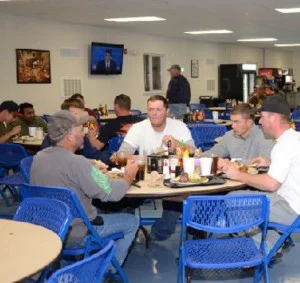
Dining Hall at a Target Logistics Property

Target Logistics, a Boston-based builder and operator of housing projects primarily for the energy industry, secured a 30-million contract to provide lodging for Bakken Shale oilfield workers over the next three years.

According to the company, it will provide workforce housing to one of the largest independent (non-integrated) crude oil and natural gas companies in the United States. Target Logistics did not reveal their client in a company statement announcing the new contract in early April 2014.

Fueled by double-digit, oil-weighted production growth, this exploration and production pioneer turned to us for a well-organized, upgraded housing solution,” says Target Logistics President and Chief Operating Officer Brad Archer.

Unlike other housing  in the Bakken Shale region, the activity of residents is monitored. The company has strict rules against alcohol on the premises and guests of workers are not allowed to stay overnight, including worker's spouses.

The way it works is oil companies pay Target Logistics to house and monitor their workers, and the oil company then offers housing accommodations to workers as part of their compensation. This is important to companies seeking to retain employees in a region where there are limited housing options, and other companies vying for workers with attractive housing packages.

Recently, a study done by ApartmentGuide pushed Williston, ND to the top spot for the highest rent area in the U.S. According to the publication, a 700-square-foot, one-bedroom, one-bath apartment in Williston, North Dakota can cost more than $2000 per month.

Read more: Williston, ND Rent Soars Past Highest Rent Areas of U.S. to Top Spot

Dormitory-style housing, such as that offered by Target Logistics to employees of certain companies, will not be an option for everyone. In which case, there are other options to consider. Check out the Lodging page on BakkenShale.com to see recent postings for Bakken housing, hotels and man camps.

Read more at targetlogistics.net
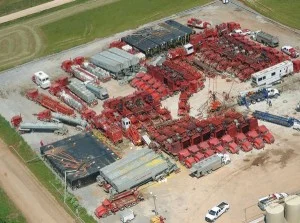
North Dakota To Implement New Regulations Combating the Disposal of Radioactive Waste

Frack Job
Frack Job

Beginning on June 1st, 2014, North Dakota will begin enforcing new regulations to combat the illegal disposal of radioactive waste. Leak proof containers will now be required at injection well-sites to store "oil socks"*, which are used to filter silt from waste water that is yielded from hydraulic fracking. The oil socks accumulate radium from the soil, rock and water present in the waste water.

According to the Environmental Protection Agency (EPA), the average concentration of radium in wastewater sludge from oil and gas production is about 75 picocuries per gram. Currently, there aren't any designated dumps in the state that accept radioactive waste below naturally occurring levels in the soil - around 5 picocuries. Montana has some designated facilities that accommodate radioactive waste under 30 picocuries per gram.  As a result, multiple incidences have occurred where the oil socks have been disposed of improperly. Most recently, used oil socks have been found in Noonan, ND, at a deserted gas station, and on flatbed trailers in a landfill in Watford City, ND.

According to a Wall Street Journal report, state officials connected the Watford City, ND, incident to Riverton, WY-based RP Services, LLC. One of the company's clients, Continental Resources, cut ties with them after that discovery was made. Continental Resources is one of the largest operators in the Bakken Shale.

Fines for illegal dumping of radioactive waste can reach as high as $10,000 per incident in North Dakota. That's in addition to a $1,000 fine for standard illegal dumping.

Oil sock - absorbent tube-like apparatus that filters silt in the process of pumping waste water down injection wells

Bakken Production Sets Another Record for Producing Wells - February 2014

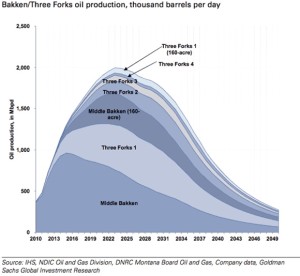
Bakken Production Chart - Goldman Sachs

In February 2014, the number of producing wells in North Dakota reached an all-time record high of 10,186. The information was released in the North Dakota Industrial Commission's (NDIC) Director's Cut for Aril 2014. The number of producing wells in North Dakota has risen month over month since the beginning of the year.

Approximately 94% of all oil production in February came from the Bakken and Three forks formation - 892,399 b/d. Another 6% came from legacy conventional pools.

Read more: Bakken Production Sets Another Record - More than 10,000 ND Wells Producing

Weather had the most significant impact on production in January and February. In the month of February alone, there were 18 days with temperatures five or more degrees below normal. Four days were recorded where wind gusts were too high for completion work. During this time frame, Hess's Tioga natural gas plant expansion plans were delayed; and company officials cited poor weather conditions as the cause. As a result, approximately 100 wells in North Dakota had to be shut-in to reduce flaring. In March, Hess began selling gas from its' Tioga plant.

Read more: Hess to Begin Selling Bakken Natural Gas from Tioga Plant

NDIC Director Lynn Helms commented, “the drilling rig count was pretty much unchanged from January to February, and the number of well completions was up slightly from 60 to 70. Days from spud to initial production decreased 8 days to 114. Investor confidence appears to be growing. There were still over 100 wells shut in for the Tioga gas plant conversion in an attempt to minimize flaring, but the biggest production impact was still the weather.

Highlights from the NDIC's Director's Cut

  • Jan Oil - 935,126 b/d
  • Feb Oil - 951,340 b/d
  • Feb Oil - 892,399 b/d from the Bakken and Three Forks (94%)
  • Jan Gas - 1,013,142 MCF/day
  • Feb Gas - 1,063,756 MCF/day
  • Jan Producing Wells - 10,114
  • Feb Producing Wells - 10,186 (preliminary)(Record)
  • 7,065 Wells or 69% are now unconventional Bakken – Three forks wells
  • 3,121 wells or 31% produce from legacy conventional pools
  • Jan Permitting - 253 drilling and 0 seismic
  • Feb Permitting - 180 drilling and 5 seismic
  • Mar Permitting - 250 drilling and 2 seismic

Read more at dmr.nd.gov

U.S. Energy Corp. and Abraxas Petroleum Provide Bakken Operations Update

U.S. Energy Corp. Rig

U.S. Energy Corp. and Abraxas Petroleum released operational updates this week in the Bakken. The two companies interests are not connected.

U.S. Energy Corp. and Abraxas Petroleum are also active in the Eagle Ford Shale play in South Texas.

Read moreAbraxas Petroleum Operations Update Reveals Strong Initial Production (IP) Rate for McMullen County Well

Read more: U.S. Energy Corp Provides Operations Update for Buda Limestone Wells

Abraxas Petroleum Williston Basin Operations Update

Abraxas is active in McKenzie County, ND. The company's Jore 1H, 2H and 4H are scheduled for fracking, following the completion of an Eagle Ford well. Abraxas owns a working interest of 76% in these wells.

On Abraxas' first Middle Bakken downspacing test, Raven Rig #1 successfully drilled and cased the surface and intermediate sections of the Ravin 6H and Ravin 7H. The company is now drilling the intermediate sections of the Ravin 5H, which will be followed by the intermediate section of the Ravin 4H. Abraxas owns a working interest of 51% in its' Ravin West pads.

Bob Watson, CEO of Abraxas, said in a company statement,”in the Bakken, weather has abated and we plan to be on location in the coming weeks to frac our three well Jore pad. Drilling continues to run quite smoothly on the Ravin pad. Success on this initial downspacing test obviously carries with it significant reserve and inventory implications for the company.

U.S. Energy Corp. Williston Basin Operations Update

U.S. Energy Corp. has interests across 84,480 gross (3,225 net) acres in Williams, McKenzie and Mountrail Counties, North Dakota. At the end of 2013, the company had participation in 101 gross (10.7 net) Bakken and Three Forks formation producing wells. Due primarily to weather-related issues in North Dakota, the company's Williston Basin production decreased by ~24% during the first two months of 2014 to an average of ~ 625 boe/d as compared to 817 boe/d in the fourth-quarter of 2013.

Read more at abraxaspetroleum.com

Read more at usnrg.com

U.S. Senators Appeal to Senate Appropriations Committee for Railway Safety Funding

Crude Oil Train Passing Mountain

Approximately 70% of the oil produced in North Dakota is transported by rail. Safety concerns mounted after an incident where two BNSF operated trains carrying Bakken crude collided and derailed near Casselton, ND, in late December 2013. The National Transportation Safety Board (NTSB) said about 400,000 gallons or ~950 bbls of oil were spilled. Now, Senators from across the country are appealing to the Senate Appropriations Committee for railway safety funding this month.

In early April of this year, North Dakota Republican Senator John Hoeven, who sits on the Senate Appropriations Committee, called on fellow members to support railway safety measures and a push for more rail inspectors. Specifically, Hoeven would like to see funding go to the Federal Railroad Administration (FRA) and the Pipeline and Hazardous Materials Safety Administration (PHMSA).

Read moreAre More Pipelines and Rail Safety Measures Needed in Bakken - Senator John Hoeven - Video

In January of this year, PHMSA issued a safety alert for Bakken crude due. The alert reinforced the need to test, characterize, classify, and where appropriate de-gassify the crude oil before transportation. PHMSA is also working on new regulations for double hulled tankers.

Read more:Department of Transportation's PHMSA Issues Bakken Shale Oil Shipping Safety Alert

On a related note, several U.S. Senators appealed to the Senate Appropriations Committee in Washington D.C. for rail safety funding in a joint-letter on April 4th. The letter was signed by 16 U.S. Senators, and highlighted the "Safe Transportation of Energy Products Fund".  

A Safe Transportation and Energy Products Fund would provide U.S. Department of Transportation new flexibility to address emerging issues related to the transportation of Bakken crude and other energy products – including, but not limited to: more expeditious rulemakings, technical studies, increased rail and energy product inspections, safety mitigation and response planning, first responder training, and community outreach. Additionally, the Fund would provide needed additional resources to complete Operation Backpressure, a study of the qualities and characteristics of crude oil in the United States. Completion of this study is an important step because its results will inform future regulatory action.

Senate Appropriations Subcommittee hearing will take place this week, Wednesday, April 9th, to examine the level of federal resources that should be allotted for railway safety. North Dakota Democratic Senator Heidi Heitkamp will be in attendance at the hearing to ask questions of the scheduled witnesses.

The derailment in Casselton and other recent rail crashes have rightly kept this issue on the minds of many in Washington and across the country. And I’m continuing to push for the issue of rail safety to remain front and center, said Heitkamp.

Read more at hoeven.senate.gov

Read more at heitkamp.senate.gov

Read more at franken.senate.gov