
Wood Mackenzie Forecasts $15 Billion on Bakken Drilling and Completions - 2014

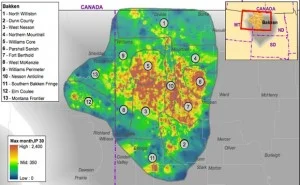
Wood Mackenzie Bakken and Three Forks Map

According to the oil and gas research and consulting firm Wood Mackenzie, $15 billion will be spent on drilling and completion in the Bakken in 2014, second only to the Eagle Ford Shale. This year, oil production is expected to reach the 1 million b/d mark, and grow markedly beyond that figure over the next 5 - 6 years.

Read more: Bakken Production Sets Another Record - More Than 10,000 ND Wells Producing

We expect Bakken/Three Forks oil production to average 1.1 million barrels a day (b/d) in 2014, growing to 1.7 million b/d in 2020,” says Jonathan Garrett, upstream research analyst for Wood Mackenzie.

The firm's analysis shows the Bakken and Three Forks plays hold close to $118 billion in value. Despite infrastructure concerns, estimates indicate operators will recover more than 20 billion bbls of oil reserves throughout the life of the play.

Continental Remains Top Bakken Operator

In 2014, Continental Resources remains the top Bakken operator, with more than 1.2 million acres according to Wood Mackenzie. The value of the company's proved reserves in the Bakken are ~ $14.5 billion.

Read more: Continentals Proved Reserves in the Bakken Valued at $14.5 Billion

In 2013, Continental conducted multiple tests of the Three Forks . Wood Mackenzie indicates the company has the most advanced delineation program in the deeper Three Forks benches.

Wood Mackenzie Analysis of Bakken Three Forks Sub-Plays

Current figures show the highest initial production rates are on the Nesson Anticline sub-play, with 30-day IP rates of 1000 boe/d. Estimated ultimate recovery (EUR) rates are the highest in the Fort Berthold sub-play at nearly 700,000 barrels of oil equivalent (boe).

In the Southern fringe sub-play, wells targeting the Three Forks formation outperformed Bakken wells. Similar results for Three Forks wells were also found in the North Williston and Williams Perimeter sub-plays.

Wood Mackenzie also indicates in their report that infrastructure constraints will not impact the pace of the play's development. Currently, 73% of crude leaves the Williston Basin by rail.

Read more at woodmac.com
Marathon Accelerates Activity in The Bakken and Other US Domestic Plays

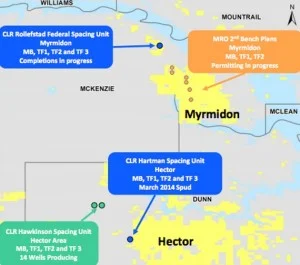
Marathon's Bakken and Three Forks Acreage Map

Marathon is continuing to ramp up its presence in US domestic shale plays, with increased activity expected in the Bakken Shale through the end of 2014. In a company statement in late March 2014, officials revealed that Marathon hit its target of a 28-rig program across the Eagle Ford, Bakken and Oklahoma-Woodford Shale plays at the end of January.

Read more: Marathon Oil's Bakken Production Drives North American E&P Segment Income Up 38%

Marathon Oil’s CEO Lee Tillman said, “We continue to have high confidence in our ability to deliver on our North America long-term production growth targets underpinned by strong resource growth through downspacing and well optimization. In addition, we are progressing the evaluation and appraisal of co-development opportunities with the Eagle Ford’s Austin Chalk and the Bakken’s deeper Three Forks benches.

Marathon Bakken Operations Update

According to Marathon, the company's Bakken acreage accounts for ~800 mmboe in proven and probable reserves and resource potential. As of March 2014, Marathon had a 6-rig drilling program, and anticipates 75 - 85 net wells across the play in 2014. The company also expects to complete 20 - 24 net wells by the end of the year. The Bakken budget for 2014 remains at approximately $1 billion and 29% of the company' 2014 capital budget.

Marathon Targeting Deeper Three Forks Benches in Myrmidon Area

The Three Forks First Bench accounts for ~23% of proven and probable reserves. 45 gross operated wells are planned for the Three Forks in 2014. Six wells are planned in the lower benches of the Three Forks between 2014 - 2015. The initial focus will be on the Myrmidon area.

Read more at marathonoil.com

Magnum Hunter Bakken 2014 Capital Budget - $52 Million

Magnum Hunter 2014 Cap Ex Budget

Magnum Hunter sold off its non-core Eagle Ford assets in 2013. In 2014, the company is focusing on its core Appalachia and Williston Basin areas. $52 million of the company's $400 million capital budget will be spent in the Williston Basin in 2013. 65% of the budget will be spent on the company's Appalachia assets.

Read moreMagnum Hunter Signs Option to Sell Pearsall and Eagle Ford Assets

In a company statement, Magnum Hunter CEO Gary Evans said, “we made the decision to sell our Eagle Ford assets [] for a contracted price of $401 million and redeploy those proceeds to our two remaining core areas, Appalachia and the Williston Basin. Revenues were still up over 72% and EBITDAX increased 48%. We drilled 21 gross wells (12.5 net) in the Marcellus and Utica resource plays and drilled 72 gross (24.6 net) in the Bakken and Three Forks Sanish plays of the Williston Basin.

Magnum Hunter Bakken & Three Forks Fourth Quarter Operations

In the fourth-quarter of 2013, Magnum Hunter drilled 15 gross (6.2. net) in the Bakken/Three Forks formations. In its operated areas, the company drilled 2 wells, and in non-operated areas, 13 gross (4.2 net) wells were drilled.

Initial production (IP) rates varied across the company's Williston Basin acreage. In the Middle Bakken Formation, six two-mile lateral wells completed, with an average 24-hour IP rate of 561 boe/d and a 30-day rate of 389 boe/d. Two one-mile laterals were also completed in the Middle Bakken. At the end of the year, one well had a 24-hour IP rate of 680 boe/d and a 30-day rate of 253 boe/d. In the Three Forks/Sanish Formation, seven two-mile lateral wells  were completed, with an average 24-hour IP rate of 584 boe/d and a 30-day rate of 287 boe/d. One one-mile lateral was also completed in the Three Forks/Sanish. It had an a 24-hour IP rate of 760 boe/d and a 30-day rate of 282 boe/d.

Magnum Hunter 2013 Bakken & Three Forks Capital Spending

Upstream capital spending in the Williston Basin during the fourth-quarter was $19.7 million in 2013. For the full-year, the company spent $131.8 million. That was ~43% of the company's total upstream capex budget for the year.

Vermilion Energy Buys Bakken Assets in Saskatchewan - $345 Million

Bakken Shale Map
Bakken Shale Map

Vermilion Energy purchased $345 million in Saskatchewan acreage and other assets in mid-March 2014 from an undisclosed seller. With the acquisition, Vermilion establishes a long sought after core area in the Williston Basin. The assets include some Bakken and Three Forks properties.

In a company statement, Vermilion officials stated, “we have been evaluating producing entry opportunities into this prolific area for an extended period of time, but had not previously been able to structure a transaction that met the stringent requirements of our dividend growth model.

Vermilion Acquisition Details

Assets include approximately 57,000 net acres of land (approximately 80% undeveloped) covering the Midale, Frobisher, Bakken and Three Forks/Torquay formations. Production from the assets is projected to be approximately 3,750 boe/d (97% crude oil) during 2014.  More than 90% of the current production base will be operated by Vermilion.

Vermilion Drilling and Development from Acquired Assets

The majority of production and development drilling opportunities from the acquisition will be from the Midale formation, with additional opportunities in the Frobisher, Bakken and Three Forks/Torquay formations. The company has identified 175 (152 net) potential drilling locations collectively targeting these formations. Total proved and proved plus probable reserves attributed to the Assets at the end of February 2014 were 10.3 mmboe (81% crude oil and natural gas liquids) and 16.5 mmboe (81% crude oil and natural gas liquids), respectively.

Read more at vermilionenergy.com

North Dakota Campaign Seeks to Grow Workforce for In-Demand Jobs

Bakken Oil Workers
Bakken Oil Workers

North Dakota officials announced a new workforce recruitment campaign aimed at attracting a permanent private-sector workforce to keep pace with the state's growing economy. The “Find the Good Life in North Dakota” campaign is targeting people in states with chronic unemployment, and people in industries that are high-demand in North Dakota, including: engineering, healthcare, energy, skilled trades, transportation and information technology.

The campaign is set to launch in May 2014.

Visit the BakkenShale jobs page

The Bakken Shale oil boom has been the primary reason for job growth in the state. Well-paying opportunities in the oil patch have been plentiful, attracting workers from across the country; however, the growth of the workforce has caused some issues over the past several years. Housing shortages, particularly near Williston, ND, which is considered to be the epicenter of the oil boom, have caused the price of rent to shoot through the roof. Crime and other factors affecting quality of life near the oil patch have also been cause for concern among locals and workers relocating to the area for well-paying opportunities.

Read more: Williston, ND Rent Soars Past Highest Rent Areas of U.S. to Top Spot

Despite the growing pains caused by the boom, N0rth Dakota leads the nation in job growth, and the state's campaign hopes to continue that trend.

In a statement released by the North Dakota Economic Foundation, Lt. Governor, Drew Wrigley, said, “To sustain [our] growth, we need to ensure that the jobs we are creating are filled with highly-skilled workers, and this campaign is a tremendous opportunity to expand our workforce and promote the quality of life that North Dakota has to offer.

The campaign is also placing an emphasis on attracting veterans and active military transitioning to civilian life and employment.It is estimated that 250,000 service men and women will be exiting the armed forces in the coming years and the campaign will invite them to start their next career in North Dakota.

The State of North Dakota has provided $400,000 in matching funds to launch the project.

Read more at nd.gov