
Emerald Oil Increases Bakken Production by 80% in 2013

Click to Enlarge
Emerald Acreage Map

Emerald's total production increased by 80% in 2013 over 2012 from ~935 boe/d to ~1690 boe/d. The production increase was attributable to the addition of 10.58 net operated Bakken and Three Forks wells in 2013.

Since the beginning of 2013, the company has acquired ~67,700 net acres. The most recent Bakken acreage acquisition took place in January, and cost Emerald $74.6 million.

Read more: Emerald Acquires Acreage in the Williston Basin for $74.6 Million

Emerald's Bakken Fourth-Quarter Production and 2013 Reserves

Emerald had a strong fourth-quarter in the Bakken, with average daily production of 2,430 boe/d.

McAndrew Rudisill, Emerald’s CEO, stated, “2013 was a transformational year for Emerald. We successfully drilled and completed multiple Middle Bakken and Three Forks wells, tripled our operated acreage position and monetized the majority of our non-operated assets.

t the end of 2013, Emerald had total proved reserves of ~13.2 mmboe, all of which were located in the Williston Basin. Emerald's proved reserves increased approximately 147% during 2013 primarily as a result of our successful operated well program.

Emerald's Bakken 2014 Drilling and Production Strategy

In 2014, Emerald has plans to add another rig to it's drilling program. The company expects to achieve an exit rate of 4,250 boe/d, with an average production rate of 3,550 boe/d.

In a company statement, Rudisill, said, “in 2014, our production will continue to grow as we add a third rig to our drilling program. The third rig is currently moving to location in our Easy Rider focus area and will soon begin drilling, earlier than originally anticipated. Due to the strong performance of our Low Rider Middle Bakken wells and positive indications from our Low Rider Three Forks wells, we are actively reviewing increased downspacing assumptions and raising our stated Low Rider type curve. We are very focused in 2014 on lowering operating expenses and driving greater drilling and completion cost efficiencies.

Emerald plans to add an additional 18.2 net operated wells by the end of 2014.

Read more at emeraldoil.com
Newfield Bakken Production Increases 40%, Exceeds 2013 Estimates

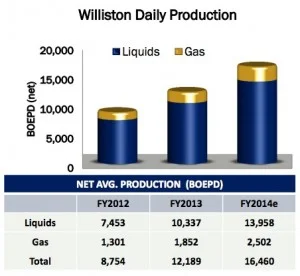
Newfield Williston Basin Production Chart

Newfield's Bakken net production in 2013 was ~4.4 MMBOE or ~12,000 boe/d. That's a 40% increase over 2012 production. At the beginning of 2013, the company had only estimated a production growth rate of 15% year-over-year in the play.

In 2014, Newfield will continue its current 4 rig program, and expects to achieve 35% to 40% year-over-year production growth. Capital expenditures are set at $330 million for 2014.

Read more: Newfield Completes Record Bakken Wells

In a company statement, CEO Lee Boothby said, “in 2013, we twice raised production guidance and once again, exceeded our guidance ranges in the fourth quarter, both domestically and internationally. The 2013 production from continuing operations was 40.1 million barrels of oil equivalent, exceeding our beginning-of-year estimates. The outperformance was primarily related to the Williston and Anadarko basins.

Newfield Bakken and Three Forks Activity in 2013

In the Bakken and Three Forks region, Newfield completed 42 wells and lowered average well costs to $8.4 million. The company drilled eight wells in the Three Forks. Seven test wells targeted the first bench and one was drilled in the second bench. The company indicates that it will continue testing these prospective horizons beneath the Middle Bakken.

In the Middle Bakken, 34 wells had an average gross initial production (IP) of 2,233. In the Three Forks, eight wells had an average gross initial production (IP) of 2,091.

Newfield Highlights

  • Newfield's Bakken net production increased 40% in 2013 to ~12,050 boe/d
  • Newfield completed 42 wells and lowered average well costs to $8.4 million
  • Newfield Three Forks drilling tested seven wells in the first bench and one well in the second bench
  • In the Middle Bakken, 34 wells had an average gross initial production (IP) of 2,233 in 2013
  • In the Three Forks, eight wells had an average gross initial production (IP) of 2,091
  • In 2014, Newfield expects to achieve 35% to 40% year-over-year production growth.

Read more at Newfield.com

Nearly Half of Halcon 2014 Budget Targeting Bakken - ~$475 Million

Halcon Bakken Acreage Map

Halcon is focused on drilling wells in the Fort Berthold area in 2014 and anticipates spending approximately 49% of its total drilling and completions budget in the Williston Basin. Based on previous budget estimates, that's about ~475 million.

Read more: Halcon Holds Production Guidance & Lowers its 2014 Capital Budget

The company's plan for 2014 is to focus on its "de-risked" acreage, which includes the Fort Berthold area.

Floyd Wilson, CEO, said in a company statement, “our focus in 2014 is on drilling wells in the sweet spots of our de-risked acreage in the Williston Basin and El Halcón. We will also begin drilling wells on our newly acquired acreage located in what we believe to be the core of theTuscaloosa Marine Shale. We are primed for growth and have a deep drilling inventory. We are committed to maintaining capital discipline and dedicated to improving capital efficiency.

Halcon's 2014 Bakken Guidance

In the first-quarter of 2014, Halcon anticipates weather-related production interruptions in the Bakken.

For the full-year, the Company plans to operate an average of 4 rigs and spud 40 to 50 gross operated wells. Halcon also anticipates participating in 200-225 gross non-operated wells, with an average working interest of 3%.

Halcon's Fourth-Quarter Bakken Production

In the fourth-quarter of 2013, Halcon Resource's Bakken production increased by 15% over the third-quarter to 24,125 boe/d, despite adverse weather conditions. Company estimates accounted for weather-related impacts of ~1,040 boe/d.

Halcon's Fourth-Quarter Bakken Activity

Halcon operated an average of five rigs in the Bakken, and participated in 50 non-operated wells, with an average working interest of 3% in the fourth-quarter of 2013.

In the Fort Berthold area, the company spudded eight wells and broutght 10 wells online. For some of Halcon's Fort Berthold area wells, strong results came from the application of the "slickwater frac" technique. The company plans on continuing this practice in 2014.

At Winter NAPE, Wilson, was quoted, “[the company’s] most recent wells in the Bakken are the best ever.

Halcón also spudded four wells and put two wells online in Williams County in the fourth-quarter.

Read more at halconresources.com

Whiting Hits Record Production in the Fourth-Quarter of 2013

Whiting Bakken Acreage Map

Whiting Petroleum had record production in 2013 of 94,090 boe/d across its portfolio. That's up 14% from 2012 production of 82,540 boe/d.

In the fourth-quarter of 2013, Whiting's production hit the 100,000 boe/d mark. That's up 9% from the third-quarter.

The strong production numbers are due largely to the company's development of core Bakken assets in North Dakota and Montana.

Read more: Whiting Expands Bakken Position and Tests New Completion Designs in the Third Quarter

Whiting CEO, James Volkner, said, “with full-scale development underway at such fields as Pronghorn, Hidden Bench and Missouri Breaks, we generated excellent results in 2013. In the wake of this development, we posted records in production, proved reserves and discretionary cash flow.

Whiting Petroleum's Bakken & Three Forks Fourth-Quarter Production

Whiting's fourth-quarter production was up across its core Bakken North Dakota and Montana assets. Production numbers for the fourth-quarter are as follows:

  • Western Williston Basin - 17,790 boe/d
  • Southern Williston Basin - 15,065 boe/d
  • Sanish Field - net production of 40,370 boe/d

Whiting's Western Williston Basin Highlights - 2013

Whiting's Western Williston Basin assets are comprised of the Hidden Bench, Tarpon, Missouri Breaks and Cassandra fields. These areas represent a total of 204,198 gross (121,909 net) acres.

Production was up 30% for Whiting's Western Williston Basin assets from the third-quarter total of 13,710 boe/d. Among all of Whitings assets, this is the largest production increase quarter-over-quarter.

In the Hidden Bench Field, Whiting tested its new completion design, which utilizes cemented liners. Two wells in this field where the completion design was applied yielded an average of ~1,320 boe/d per well. According to the company, wells completed using the new completion design had average initial production (IP) rates 53% better than wells completed with Whiting's previous completion design.

Whiting's Southern Williston Basin and Sanish Field Highlights - 2013

Whiting's Southern Williston Basin assets include the Pronghorn and Lewis & Clark fields. These areas represent 392,483 gross (263,376 net) acres. Production was up 6% in the fourth-quarter 2013 from third-quarter 2013 production of 14,610 boe/d.

In the Sanish, average net production in the fourth-quarter increased 10% from third-quarter production of 36,840 boe/d. Two infill wells, testing an eight-well testing pattern, yielded an average of ~1,350 boe/d per well. These wells were completed using the company's new completion design.

Read more at whiting.com

QEP Bakken Production Increases in Q4 2013, Despite Adverse Weather Conditions

QEP Resources Bakken Three Forks Acreage Map

QEP Resources grew its Bakken and Three Forks production in the fourth-quarter, despite adverse weather conditions, achieving net average production of 27,700 boe/d (96% liquids). That's a 30% increase over third-quarter 2013 production, which was 21,300 boe/d.

Read more: QEP Resources Bakken & Three Forks Production Surpasses 21,000 boe/d

The company brought 26 operated wells to sales in the fourth-quarter, with good initial production rates. 17 of those wells were in the South Antelope, and their average 24-hour initial production (IP) rate was ~3,025 boe/d. The other nine wells were in the Fort Berthold Reservation, with an average 24-hour initial production (IP) rate of 1,850 boe/d.

In 2013, QEP also saw the value of its South Antelope property rise to $2.8 billion from a $1.14 billion investment. Production from this asset grew throughout the year.

Read more: QEP Resources South Antelope Bakken Properties Valued at $2.8 Billion at Year-End 2013

QEP Energy’s capital investment program resulted in a 62% increase in crude oil production over last year driven by a 133% increase in production from the Williston Basin. Crude oil volumes represented 20% of QEP Energy’s production in 2013, a substantial increase from 12% in 2012 and 8% in 2011,” said Chuck Stanley, CEO, QEP Resources.

QEP Outside Operated Bakken and Three Forks Wells

QEP Resources also participated in 22 outside-operated Bakken or Three Forks wells that were completed and turned to sales during the fourth-quarter. These wells had an average working interest of 7%.

At the end of 2013, QEP had interests in 31 outside-operated wells in the process of being drilled, with an average working interest of 10%. Five outside-operated wells were waiting to be completed with an average working interest of 5%.

QEP Bakken Rigs Running at End of Year

At the end of the fourth-quarter, eight rigs were operating in the Williston Basin. Six of those rigs were located in the South Antelope, and two were in the Fort Berthold Reservation. QEP also had eight operated wells waiting on completion, with an average working interest of 94%.

Read more at qepres.com