
Marathon Oil's Bakken Production Drives North American E&P Income Up 38%

Marathon Oil Bakken Map

Marathon Oil's Bakken production helped drive the company's North American E&P segment income to $529 million in 2013, compared to $382 million in 2012.

The approximately ~38% increase was primarily due to higher liquids volumes from the Eagle Ford, Bakken and Oklahoma resource basins.

Read more:Marathon Oil Plans to Spend $1-Billion in the Bakken in 2014

Marathon Q4 2013 Production and 2014 Bakken Budget

[ic-l]Marathon Oil averaged approximately 40,000 net boe/d of production in the Bakken during the fourth quarter. That's approximately a ~5% increase from 38,000 net boe/d in the third quarter of 2013.

In 2014, Marathon will spend $1 billion of its $3.6 billion budget in North America in the Bakken. As a result, Bakken production is expected to grow to a little less than 50,000 boe/d.

Marathon Oil's average Bakken production by commodity is as follows:

  • 90% crude oil
  • 4% NGLs
  • 6% Natural Gas

Marathon Hits Q4 2013 Production Target

In the fourth quarter, the company reached total depth on 15 gross wells and brought 22 gross wells to sales, hitting its year-end exit rate estimate of 40,000 boe/d.

During 2013... our strong year-over-year net production growth in the top U.S. liquids resource plays — 136 percent in the Eagle Ford, 34 percent in the Bakken and 68 percent in the Oklahoma resource basins — demonstrated our ability to drive superior operating results,” said Lee M. Tillman, Marathon Oil’s president and CEO.

The company improved it's average time to drill a well in the Bakken by 16% compared to a year prior, averaging 15 days spud to total depth. Drilling and completion costs have decreased approximately 10% compared to the fourth quarter 2012.

Marathon Highlights for 2013

  • ~5% increase in production from Q3 (38,000 boe/d) - Q4 (40,000 boe/d)
  • North American E&P income Up ~38% from 2012 to $529 million thanks to unconventional drilling
  • 16% faster rate to drill a well than Q4 2012 (approx. 15 days)
  • Drilling and completion costs decreased 10%
  • Marathon sets capital budget in Bakken at $1 billion in 2014

Read more at Marathon.com
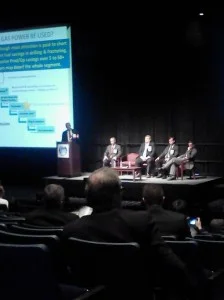
Winter NAPE Expo Business Conference Highlights - 2014

NAPE
NAPE

The NAPE Expo is a North American event with some international influence, which features key players in the oil and gas industry. The business conference theme for 2014 was sustainability in the U.S. oil and gas industry.

The conference touched on key issues such as hydraulic fracking, sustainable business strategies and technological innovations.

Multiple speakers  put a spotlight on the practice of hydraulic fracturing. Here are some of their comments:

  • Former Secretary of the Interior, Ken Salazar, said, "I believe hydraulic fracking is safe... there is not a single case where fracking has caused an environmental problem for anyone."
  • David Blackmon, Dir. FTI Consulting, said, "the biggest issue by far facing the industry today is water."
  • "Treatment and recycling will be one of the main drivers moving the industry forward over the next 10 years," said Andrew Slaughter, VP, Upstream Research, IHS

The Business of Unconventional Drilling and Technology

  • Robert Turnham, CEO, Goodrich Petroleum on business strategy: "we move early, identify opportunities and take the risk up-front. If you move early, then you enjoy lower royalty burdens straight off the top."
  • Industry targeting the "sweet spots" in the shale plays. Floyd Wilson, CEO, Halcon Resources, on the Bakken: "[the company's] most recent wells in the Bakken are the best ever."
  • Apache converting waste gas to electricity for field grid usage
  • General industry focus on artificial lift technology in shale drilling to quickly drain reservoirs
  • New diverter technology being utilized to make marginally economic wells profitable

Other Highlights from the Conference

  • Luke Keller, VP, BP America, said, "[the] U.S. could achieve energy independence by 2035."
  • "$2000 financial benefit to every American household by 2015 due to unconventional drilling of natural gas," according to Don McClure, VP, Government Stakeholder Relations and Legal, EnCana Oil and Gas USA
  • "Tremendous amount of light sweet crude is about to be discovered and put into the marketplace [in the U.S.]" according to Charles McConnell, Rice University
  • Industry encouraged to support better outreach and education initiatives via social media outlets

Learn more about NAPE by visiting napeexpo.com

Oasis Sells Bakken Acreage - Strong Production Growth in 2014

Oasis Petroleum Bakken Acreage Map - Acquisition Included

Oasis Petroleum set its 2014 capital budget at $1,425 million, with 96% of expenditures ($1,367 million) earmarked for drilling and completion of its operated and non-operated wells.

The company saw production growth jump ~50% in 2013 from its' 2012 figures, and expects continued growth in 2014.

Oasis Anticipates Growing Production in 2014

Oasis plans on increasing production to 46,000 boed/d - 50,000 boe/d by the end of the year.

If the company reaches it's midpoint estimate of 48,000 boe/d, then that will be ~42% higher than total production of 33,904 boe/d in 2013.

Oasis Petroleum Divestiture of Bakken Acreage

A portion of Oasis's capital budget for 2014 will come from a $333 million sale in January of its' non-operated Sanish properties and a few non-operated leases adjacent to the Sanish.

Whiting Petroleum is believed to be the operator of the Sanish properties, and would be a logical buyer, although, Oasis has not disclosed any information about the purchaser.

Mr. Nusz said, “The funds from the Sanish divestiture strengthen our liquidity position to execute on our accelerated drilling program in 2014. The transaction is consistent with our growth strategy as we de-lever the balance sheet and put the capital into our high return operated projects.

Properties ear-marked in the sale are 8,354 net acres and 28.2 net producing Bakken and Three Forks wells.  Production from the properties was 2,691 boe/d during Q4 2013.

In 2013, Oasis grew its Bakken acreage to 515,314 total net acres from 335,383 net acres in 2012. With ample running room, non-operated and non-core properties become a fit for divesting. The company generated cash that can be used immediately and saved future development expenses that it can directed toward operated wells and acreage.

Oasis at a Glance in 2014

  • $1,425 million capital budget ($1,367 million for drilling and completing wells)
  • 42% production increase to 46,000 boed/d - 50,000 boe/d expected by the end of 2014
  • $333 million sale of 8,354 net acres in January 2014
  • Increase total operated rigs from 14 - 16 by second half of 2014
  • Complete approximately 205 gross (147.8 net) operated and 7.7 net non-operated wells

Northern Oil Q4 Production Up by 28% with Total 2013 Production of 4.47 mmboe

Northern Oil Growth Chart

Northern Oil saw production numbers increase in Q4 of 2013 by 28%, bringing estimated boe/d to ~13,900. Total production for the entire year was 4.47 mmboe.

The company estimates their realized price for a barrel of oil equivalent (boe) will be between $74.00 - $75.00.

Northern Bakken Production Growing and Costs Decreasing

Northern Oil continues to experience a growing trend in the Bakken, with its Q4 LOE (lease operating expense) down by ~7% from ~8.40 per boe in Q3.

The company's growth pattern is leveling off slightly in the Bakken from its excpetional rate in 2012, when the company grew production by 95%.

We experienced solid sequential production growth driven by strong activity levels during the fourth quarter,” said Northern’s CEO Michael Reger.

n 2013, Northern Oil added 531 gross (40 net) wells to production. At the end of the year, the total well count for the company stood at 1,758 gross (146.2 net) wells.

Growth Concurrent with Strategic Company Decisions

Growth in 2013 was also concurrent with major strategic decisions for Northern Oil. In Q3 of 2013, the company re-purchased more than two million shares of its common stock.

Read more: Northern Oil and Gas Repurchases Stock - Grows Bakken 20%

Weather Slowing Production at Beginning of 2014

Inclimate weather in the Bakken at the beginning of this year has had an impact on production, but Northern claims it's drilling operations are robust, with 190 active drilling rigs in North Dakota.

CEO Micheal Reger said, “completion activity has been slower given significant cold weather during the month.

Northern also saw slows in production in 2013 due to poor weather conditions in the first quarter of 2013.

Read more: Northern Oil and Gas Bakken Production Growth Slowed - Weather

Northern Highlights for 2013

  • Q4 2013 Bakken production up 28% to ~13,900 boe/d
  • Total production was 4.47 mmboe
  • 531 gross (40 net) wells added to production
  • Company total well count at 1,758 gross (146.2 net) by end of year
  • Q4 LOE (lease operating expense) down by ~7% from ~8.40 per boe in Q3
  • Q4 2013 realized price of boe estimated at ~74.00 - ~75.0

WBI Energy's Bakken Natural Gas Pipeline Enters Open Season - Dakota Pipeline

WBI Dakota Pipeline
WBI Dakota Pipeline

The open season to secure commitments for WBI Energy's natural gas "Dakota Pipeline" began on January 30th.

WBI Energy, a subsidiary of MDU Resources, announced plans to build a 400 mile natural gas pipeline at an estimated cost between $650 - 700 million dollars in June 2013. Costs for the project will remain at $650 million, but only cover 375 miles, shaving off 25 miles of pipeline.

Natural Gas Pipelines will Alleviate Bakken Flaring

It may not come as a surprise to readers on this site, but according to the North Dakota Industrial Commission (NDIC), ~30% of natural gas produced in the state is flared.

Without effective infrastructure in-place, no other economically viable choice exists for companies targeting the oil rich Bakken Shale.

The Dakota Pipeline offers another avenue to move Bakken-produced natural gas out of the area and complements our other ongoing activities to build connections to several natural gas processing facilities,” said David Goodin, CEO of MDU Resources. “The increase in natural gas pipeline capacity out of the region will provide additional transportation opportunities for new production as it comes on line, as well as more capacity for natural gas captured through industry’s efforts to reduce the flaring of this valuable resource.

WBI Expects Positive Response to Dakota Pipeline Open Season

WBI CEO, Steven Bietz, is optimistic about the "Dakota Pipeline", and indicated in a statement released by the company that there is viable interest in the marketplace.

This project provides access to markets in the Mid-Continent and Great Lakes regions... Through the open season process, we intend to secure capacity commitments for the Dakota Pipeline and begin the process for obtaining the necessary permits and regulatory approvals.

Pipeline Route and Construction

The proposed route for the natural gas pipeline will provide access to interconnections with other pipelines operated by Great Lakes Gas Transmission Limited Partnership, Viking Gas Transmission Company and possibly TransCanada Pipelines Limited. Interconnection points would be in Northwestern Minnesota.

According to the company, construction on the new pipeline could begin in 2016, with completion expected in 2017.

Read more at WBIEnergy.com