ConocoPhillips' Bakken Shale Production Up 80% in Q4 2013 to 43,000 boe/d

Bakken Rig
Bakken Rig

ConocoPhillips Bakken Shale production was 43,000 boe/d in the fourth-quarter of 2013, surpassing fourth quarter 2012 production of the formation by ~ 80%.

In the Lower 48 and Latin America, that accounted for about ~12% of the company's total production.

Read more: Conoco Phillips Increases Bakken Spending in its 2014 Budget

ConocoPhillips Production Growing Rapidly in the Bakken

In the fourth quarter of 2012, Conoco's Bakken production averaged 24,000 boe/d.

At the beginning of 2013, production was only expected to grow by 10%, but with the ~80% increase to 43,000 boe/d, Conoco is well within its 2013 target goal to produce an average of 40,000 boe/d over the next 4 - 5 years.

ConocoPhillips Capital Budget in Unconventional Drilling

In 2014, Conoco will spend ~$9 billion on its North American operations. Approximately $4.3 billion will be focused on the Bakken, Eagle Ford and Niobrara Shale. In 2013, Conoco's production in the Bakken, Eagle Ford and Permian grew 31% from ~167,000 boe/d in the fourth-quarter of 2012 to ~218,000 boe/d in 2013.

Bakken Contribution to Conoco's Reserves

The growth in unconventional drilling has contributed greatly to Conoco's reserves.

CEO Ryan Lance, said, “2013 was a significant year for the company and we achieved several important, strategic milestones... [the company] achieved conventional and unconventional exploration success... [and] our capital program yielded strong organic reserve replacement.

In 2013, Conoco added 470 million boe in Lower 48, primarily in liquids-rich shale plays, including the Bakken and Eagle Ford.

ConocoPhillips Production in 2013 and Plans Moving Forward at a Glance

  • ConocoPhillips Bakken Shale Q4 production up ~80% from 2012 to 43,000 boe/d
  • ~ 12% of ConocoPhillips Lower 48 Production is in Bakken
  • $4.3 billion will be focused on the Bakken, Eagle Ford and Niobrara Shale in 2014
  • 470 million boe in Lower 48 reserves added in 2013, primarily in liquids-rich shale plays, including the Bakken and Eagle Ford
  • 31% production growth in Bakken, Eagle Ford and Permian to ~218,000 boe/d in Q4 2013

Read more at ConocoPhillips.com

Emerald Acquires Bakken Acreage in the Wiliston Basin for $74.6 Million

Click to Enlarge
Click to Enlarge

Emerald Oil acquired 20,800 net acres in the Williston Basin for $74.6 million in two separate deals in early January.

The company now controls 85,000 net acres in the area.

With the closing of this deal, Emerald is now the operator for 75% of its acreage. The company's purchase includes Bakken and Three Forks producing properties and an undeveloped leasehold in McKenzie and Williams counties in North Dakota. Without valuing production of 350 boe/d, the company paid a little more than $3,500/acre.

McAndrew Rudisill, CEO, said, “This additional acreage expands Emerald’s presence in our Low Rider and Lewis & Clark focus areas of McKenzie County, ND where we have seen strong production growth as a result of our successful operated well program.

Roughly 19,500 of the net acres are adjacent to the company's Low Rider operating area, with 17 of the 19 drilling spacing units acquired being in this area.

Approximately 62% of the acreage acquired is already held by production, with ~350 boe/d of current net production.

Emerald Bakken Acquisition Highlights:

  • Emerald acquired 20,800 net acres for $74.6 million in the Williston Basin
  • 62% of acquired acreage is held by production at 350 boe/d
  • Emerald's assets now include 85,000 net acres in the basin

Hot Area for Acquisitions

Emerald is not the only company expanding it's acreage in the Bakken. In August of last year, Whiting Petroleum announced the acquisition of 39,310 gross (17,282 net) acres targeting the Bakken in North Dakota and Montana for $260 million.

Whiting's acreage is located in McKenzie and Williams counties in North Dakota, and Roosevelt and Richland counties in Montana.

In total, Whiting has 714,541 net acres in the region at a cost of $643 million or less than $900/acre.

Read more: Whiting Petroleum Acquires Bakken Acreage In MT & ND - $260 Million

Hess Capital Budget for 2014 Flat in Bakken at $2.2 Billion

Hess' Bakken Acreage Map

Hess plans on committing nearly half of its $5.8 billion capital budget to unconventional shale resources in 2014, with $2.2 billion slated for development of the Bakken. That's the same figure Hess earmarked for development spending in the formation for 2013, but the company's strategic focus is slightly different this year as shale costs shrink.

Although overall investments in infrastructure are down slightly, Hess still plans on allotting $350 million for completing the expansion of the Tioga Gas Plant and associated pipeline and compression projects.

Also read:Alliance Pipeline's Tioga Lateral Is Online & Moving Gas Onto Its Mainline System

Greg Hill, President and COO, said, “as a result of lower well costs and decreased investments in infrastructure projects we plan to operate 17 rigs versus 14 last year and to bring 225 new operated wells online in 2014 compared to 168 in 2013.

The other nearly 10% of Hess's capital budget for unconventional shale resources will be in the Utica Shale in Ohio, with $550 million for drilling approximately 35 wells targeting the wet gas window. That's up $95 million from the company's investment in the area last year, but that does not necessarily mean that the company's focus is shifting away from the Bakken. It does indicate however that Hess is diversifying its interests in unconventional shale resources.

Read the full release at hess.com

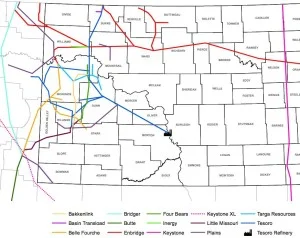
Bakken Rig Count 176 - Koch Cancels Bakken Pipeline - Jan 24, 2014

Bakken Pipeline Map
Bakken Pipeline Map

The Bakken-Three Forks rig count increased by one to 176 running over the past week. The NDIC notes around 187 rigs are active in North Dakota, but around 14 of those are in the process of moving in and rigging up.

In recent Bakken news, Koch cancelled its proposed "Dakota Express Pipeline." The Koch cancellation is surprising considering there are more than 500,000 b/d of oil moving by rail out of the basin per day at current estimates. Read more here: Koch Cancels Proposed Bakken Pipeline

The U.S. rig count stayed flat at 1,777 running over the past week. A total of 356 rigs are targeting natural gas (9 less than last week) and 1,416 are targeting oil in the U.S. (8 more than last week). The remainder are drilling service wells (e.g. disposal wells, injection wells, etc.). 179 rigs are running in the Williston Basin across MT, ND, and SD. That's up one from last week.

Not all rigs counted in our census are drilling for the Bakken, but it's close. The NDIC estimates 95% or more of activity in this region targets the Bakken and Three Forks formations.

Note: The NDIC reports 187 rigs are active in North Dakota. That is 11 more than Baker Hughes reports in the Bakken area. The difference is likely accounted for in the number of rigs actually working, rigs that might not be serviced by Baker Hughes AND rigs in areas outside of the Bakken fairway. On any given week, a certain number of rigs are in route to the next well location or idle waiting to drill the next well. The NDIC notes that around 14 rigs are in the process of moving in and rigging up.


Bakken Crime Causes Feud Between Senators

FBI
FBI

Does it seem like North Dakota and Montana have turned into the wild West over the past several years? Some folks may claim that it has, especially as crime rates continue to rise in both states. Drug offenses and a slew of other illicit activities remain an issue of great concern. In July of 2013, 2 FBI agents and an agency intelligence specialist were posted in Sidney, MT, approximately forty-five miles away from where they were originally to be posted in Williston, ND, due to a housing shortage.

Now, there is a battle brewing between senators from both North Dakota and Montana, because of the possibility that the FBI agents could be moved back to Williston. In a joint letter to FBI Director, James Covey, Senators John Hoeven and Heitkamp, requested that the agents return to Williston. Senator Jon Tester of Montana did not agree, and said the following in his letter to Covey:

Moving agents from eastern Montana to western North Dakota is not an effective response to our region’s growing problems.
— Senator Jon Tester


In 2008 when oil prices skyrocketed, cities like Williston, North Dakota and Sidney, Montana, changed overnight, as advanced drilling technologies (i.e. horizontal drilling) allowed oil companies to access the oil rich Bakken Shale. Over time, motorhomes and man camps have become a regular sight, as thousands of people have flocked to the area in search of well-paying jobs.

There's no doubt that cities like Williston, ND and Sidney, MT could easily be characterized as a boomtowns. Webster's Dictionary simply defines this as "a town that experiences a sudden growth in business and population." When that happens, what follows is generally an increase in crime-related activity.

It remains to be seen where the federal agents will be permanently posted, but one thing is certain, and that is a federal presence will continue to be necessary in the region.

Read more: Senator Jon Tester Press Release

Read more: Senator John Hoeven and Senator Heidi Heitkamp Letter