Stallion's $2.6 Million Temporary Housing Fine Reduced

Stallion-Oilfield-Services-Ltd

The Williams County Commission moved on Tuesday to approve a settlement agreement with Stallion Oilfield Services Ltd., over a proposed $2.6 million fine for temporary housing permit violations. The agreement comes after Stallion took legal action to dispute what the company considered an excessive penalty. According to Stallion representatives, the fine will now be reduced to $26,000.

The original conditional use permit, which accounts for temporary housing, was granted to Stallion in September of 2013, and allowed for twenty-five (25) housing units. The fine was levied by the commission due to conflicting definitions of what makes up a housing unit. The company considered connected units as one unit, but the county disagreed.

The real difference is in the counting.
— Stallion Attorney, Levi Anders

Stallion claims that no improper actions were taken in its implementation of its temporary housing units. The conditional use permit was reinstated for the company until May 1, 2014.

Read more: Stallion Oilfield Services, Ltd. Press Release

Bakken Permitting on BLM Lands Should Pick Up in 2014

Western ND Tribal Lands Map

Legislation aimed at improving the permitting process in the Bakken will now be in full effect, after being signed by President Barack Obama and passing approval in the US House and Senate.

The Bureau of Land Management Streamlining Act, authored by North Dakota Senators, Heidi Heitkamp and John Hoeven, will expand the service area of the Miles City, Montana office to process oil and gas production permits in western North Dakota.

The Impact on Permitting in the Bakken

The legislation is about helping to cut red tape and making the federal permitting process more timely and efficient.
— Senator Hoeven

It currently takes anywhere between 6 - 9 months to receive a permit on Bureau of Land Management (BLM) lands; however, on private lands it takes on average only 10 days. As of December 2013, 525 permits were awaiting approval on BLM lands. With the new legislation, anticipated efficiency and economic benefits are expected for both operators in the area and the State of North Dakota.

Read more at Heitkamp.senate.gov

Bakken Production Sets Another Record - More Than 10,000 ND Wells Producing

Bakken Oil Production Forecast - NDPA

The Bakken and Three Forks region are on the verge of joining an elite fraternity that only ten (10) other oilfields in the world have enjoyed - the 1-million b/d club.

Daily production in the Bakken and Three Forks region of North Dakota continues to grow at a rapid pace.

The month of November certainly indicated that the 1-million b/d target seems to be well within reach, with 908,384 b/d coming from the Bakken and Three Forks in North Dakota alone, and also accounting for 93% of state-wide production. Total state-wide production in November accounted for 973,045 b/d. For more on the most up-to-date statistics on the Bakken and Three Forks region, see the North Dakota Industrial Commission (NDIC) Director's Cut for January.

Read more:North Dakota Production will Exceed 1 Million b/d in Early 2014.

In-line with the state-wide increase in production, North Dakota set an all-time record high for the number of producing wells with 10,023. The state has 10,000 producing wells for the first time ever!

Williston Basin Sweet Crude prices are down over the past few months. The price quoted in the directors cut dropped from $85.16/barrel in October to $71.42 in November. Prices have remained relatively flat however since then.

Quick Glance:

  • Oil production up to 973,045 b/d in Nov from 945,182 b/d in Oct
  • Gas production estimated at 1.08 Bcf/d with 30% flared in November
  • Flaring was up 2% due to a Tioga Plant closure during the month
  • Permitting has held flat at ~230 per month in Nov and Dec
  • Williston crude prices are down Oct = $85.16/bbl, Nov = $71.42/bbl, Dec = $73.47/bbl
  • Natural gas prices delivered to the Northern Border Pipelin at Watford city are up to $3.86/mcf
  • 10,023 wells producing in the state
  • Average ND rig count up from 184 in Nov to 190 in Dec

Read more at dmr.nd.gov

ND Defines Stricter Rules for Pipeline Construction & Stripper Well Exemptions

A number of changes to the North Dakota Administrative Code could impact pipeline development and stripper wells in 2014. Approved by the North Dakota Industrial Commission last month, forty-seven (47) new rules were proposed, bringing the number of rules for oil and gas operations to seventy (70). According to the Department of Mineral Resources, a division of the Industrial Commission, the changes could take place as early as April 1, 2014. One particular area of the code, 43-02-03-29, addresses pipeline development in the region:

All newly constructed underground gathering pipelines must be devoid of leaks and constructed of materials resistant to external corrosion and to the effects of transported fluids. All such pipelines installed in a trench must be installed in a manner that minimizes interference with agriculture, road and utility construction, the introduction of secondary stresses, the possibility of damage to the pipe, and tracer wire shall be buried with any nonconductive pipe installed. When a trench for an oil and gas underground gathering pipeline is backfilled, it must be backfilled in a manner that provides firm support under the pipe and prevents damage to the pipe and pipe coating from equipment or from the backfill material.

The new regulations come at a time when increased scrutiny on pipeline development in the region is piquing. A Tesoro pipeline released approximately 20,000 bbls of crude near Tioga, ND, in October. The cause is believed to be related to corrosion.

Read more: North Dakota Oil Spill Recover Efforts Underway

NDIC's Authority to Define Stripper Wells Expanded

Yet another area of production that could see an impact are in wells defined as stripper wells. The Director of the Department of Mineral Resources, Lynn Helms, already had the authority to determine stripper well property status. The change could impact the number of wells receiving tax exemptions through stripper well status. The new regulations extend Helms's ability to determine a stripper well. Furthermore, the revised regulations account for horizontal drilling, relative to stripper wells:

"If a well that has previously qualified as a stripper well property is reentered and recompleted as a horizontal well, the stripper well property status on that well will terminate. "

Other facets of production worth noting that will be affected are with the notification of fires, leaks, spills or blowouts and underground injection wells.

Read more at dmr.nd.gov

Bakken Well Spuds Down - Drilling Efficiency Flat in Q4 - Baker Hughes

Bakken and Three Forks Well Spuds Q4 2013

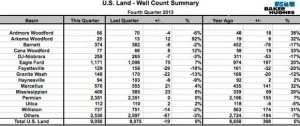
The number of wells started in the Williston Basin was down slightly from 751 wells in the third quarter to 737 wells in the fourth quarter.

Also read:Bakken & Three Forks Well Spuds Set Record in Q3

Baker Hughes also reported a drop in the average rig count during the quarter from 183 to 180 across the basin from quarter to quarter.

Drilling efficiency or the number of wells drilled by each rig held flat at 4.09 per rig.

Watch for the above drilling metrics to be impacted negatively over the coming months of winter. Harsh weather makes drilling efficiency targets hard to achieve.