Mineral Owners Sue Over Bakken Flaring

Bakken Natural Gas Flaring

North Dakota mineral owners have started filing class action lawsuits (10 to date) against oil and gas companies that are flaring gas produced from their property.

Roughly 30% or 300 mmcfd of the natural gas produced in North Dakota is flared.

Mineral owners, and the lawyers working for them, hope to force operators to pay them based on the market value of the flared gas. Even though I consider many estimates for losses high because they assume Henry Hub or a similar benchmark natural gas price, there are millions in lost royalties each month.

No matter how you look at it, operators will be more highly scrutinized and might have a bigger financial incentive to decrease flaring. This could be the straw that forces operators to build necessary infrastructure that will minimize flaring. Now that most acreage is held by production in the region, operators can be more deliberate in their development drilling.

One result might be that operators allocate resources in central locations that have access to necessary infrastructure.

The companies named in the suits include:

  • Continental Resources
  • ConocoPhillips
  • Crescent Point Energy
  • ExxonMobil (XTO Energy)
  • HRC Operating
  • Marathon Oil
  • Samson Resources
  • SM Energy
  • Statoil
  • WPX Energy

The industry will be forced to address this issue in the courts, but watch for operators to accelerate plans to reduce flaring on all fronts. Coincidentally, the ND Petroleum Council announced a new task force dedicated to flaring the day before the law suits became public.
Rigs in the Bakken Add Almost 500 Barrels of Oil Production Per Month

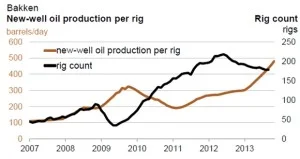
Bakken Production Added by Rig

The EIA published it's first "Drilling Productivity Report" for six major producing regions in the U.S. and the Bakken didn't disappoint.

The Bakken, along with the Eagle Ford, accounts for approximately 75% of monthly oil production growth in the U.S.

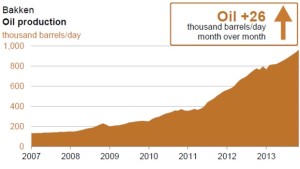
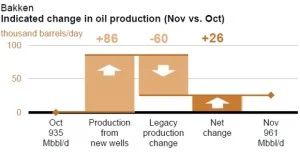
There are several highlights from the report. The average rig drilling in the area adds 450-500 b/d of oil production each month and the play is approaching 1 million b/d.

The EIA also predicts Bakken oil production will grow by 26,000 b/d in November 2013.

EIA New Bakken Production and Declines
EIA Bakken Oil Graph Oct 2013

The report will be published monthly, so we'll have updates in the coming months. View the report at eia.gov

North Dakota Oil Spill Recovery Efforts Underway - Tesoro

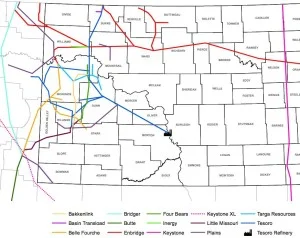
Bakken Pipeline Map
Bakken Pipeline Map

North Dakota oil spill recovery efforts are underway near Tioga in Williams County and it will likely be weeks before we know the full story.

The spill affected a little more than 7 acres and did not penetrate groundwater sources or impact wildlife.

Many have criticized the state for taking 11 days to notify the public. One reason for the delay was officials thought the spill was less than 1,000 bbls.

Tesoro now estimates more than 20,000 bbls of oil were spilled from the pipeline. Some are questioning those estimates, but again it's early and very difficult to estimate the true impact.

"As unfortunate as it is, it is actually very beneficial with a clay layer and not hitting water," one Tesoro official stated.

Tesoro and locals are actually lucky as there is thick clay layer approximately 10-12 feet deep that helped contain the oil. The seal has allowed Tesoro to recover more than 3,000 bbls already. Trenches have been dug to allow the oil to flow out of the soil. Those trenches will likely be used like french drains throughout the winter, while remediation efforts continue.

The section of pipe that was leaking has been sent to an independent lab to be studied and a replacement pipe circumventing the spill site is already being installed.

Watch for an official announcement from Tesoro as the cause and impact of the spill can be more confidently determined.

Harold Hamm Says the Bakken Shale Could Produce 2 Million b/d

Harold Hamm Continental Resources

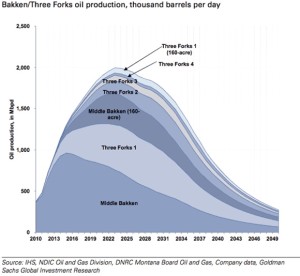
Harold Hamm followed reports from the NDIC that production had surpassed 900,000 b/d with a prediction that the Bakken will ultimately produce 2 million b/d.

Read more: North Dakota Reports Record Production Volumes in August 2013

His company, Continental Resources, controls over 1 million acres and produces approximately 80,000 boe/d from the Bakken.

A few other notable comments included:

  • We're 75% of the way to fully optimizing the Bakken
  • He believes our borders should be opened to oil exports
  • He doesn't expect an oil price crash. Oil is simply harder to find and produce than natural gas
  • Oil prices will remain in the $90-100 bbl range
  • The chances Keystone XL will be built are dwindling

Mr. Hamm was speaking at the Bloomberg Oil & Gas Conference held October 17, 2013 in Houston.

North Dakota Reports Record Production Volumes in August 2013

Bakken Production Chart - Goldman Sachs

North Dakota oil production increased 4% from a little more than 875,000 b/d in July to more than 911,000 b/d in August. Natural gas production rose ~3% and eclipsed 1 Bcf/d for the first time.

That means North Dakota accounts for more than 15% of all the oil produced and 1.5% of all the natural gas produced in the onshore U.S.

Largest Monthly Bakken Production Increase Ever in July

Bakken production increased by more than 4% or ~35,000 b/d in in August to reach 847,000 b/d. That represents significant growth over volumes of ~638,000 b/d in August 2012 and ~379,000 b/d in August of 2011.

Other notes from the August monthly NDIC Director's Cut include:

  • 287 wells were permitted
  • 9,452 wells producing
  • Average crude oil price of ~$93/bbl in August
  • Completions fell from 251 in July to 130 in August
  • Time from spud to total depth averaged 22 days
  • Time from spud to first completion rose from 79 to 105 days
  • About 450 wells are waiting to be completed

August completion levels falling should not be alarming. July completion figures were inflated by bad weather and other completion delays in prior months.

Read the full director's cut at dmr.nd.gov