Oasis Petroleum Is Testing Bakken & Three Forks Well Spacing

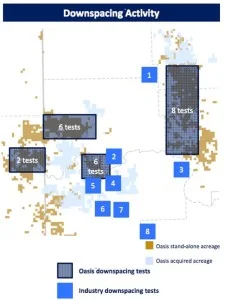
Bakken & Three Forks Well Spacing Tests

Oasis Petroleum believes the company can drill four Middle Bakken and four Three Forks wells on each 1,280-acre unit, but the future might be more dense drilling than they currently suggest.

Oasis is testing up to seven wells per formation in the Bakken and the first bench of the Three Forks (TFS 1).

The company also notes that other operators are testing as many as eight wells per formation in the Middle Bakken and Three Forks 1st, 2nd, and 3rd benches.

Watch for results over the next few months to determine how many wells can be drilled in the Bakken and the Three Forks' first bench. It will probably be late next year before we know how many wells can be drilled targeting the lower Three Forks intervals.

Oasis and Continetnal Resources have the most downspacing pilots being tested, but we'll see results from Kodiak and Whiting as well.

Slawson Planning Dual Laterals in the Upper Bakken

USGS Bakken Reserves - Petroleum System Map

Slawson Exploration has received approval to drill dual laterals targeting the Upper Bakken Shale member across several parts of North Dakota.

The company applied for field amendments allow for the drilling of multi-lateral horizontal wells in parts of McKenzie, Mountrail, and Williams counties.

The applications also gain approval for a portion of the vertical section of the wells to open into the Lodgepole formation. The opening will be used to kick off into the second lateral.

Early horizontal development in the Bakken was dominated by multi-laterals in Montana, but technical complexity has led to the use of single laterals across the state line. It will be interesting to see if Slawson determines multi-laterals are the best way to develop Bakken acreage in parts of North Dakota.

Read the full NDIC docket from August at dmr.nd.gov

Philadelphia Refinery Opens Rail Yard to Support Bakken Crude Delivery - Video

Philadephia Energy Solutions has built a state-of-the-art crude by rail unloading facility that can handle up to three unit trains. The company's two refineries south of Philadelphia, Point Breeze and Girard Point, are the largest consumers of Bakken crude. Rail receipts of 160,000 barrels arrive on a daily basis.

"Times change and if the better crudes start moving down into the Utica, we can take it by rail. If it`s in the Permian Basin, we can take it by rail," Rinaldi said. "So we`re connected everywhere and we don`t get locked in."

In total, the two refineries can process 330,000 b/d of crude oil.

Marathon Spuds Exploration Well Targeting the Tyler Formation

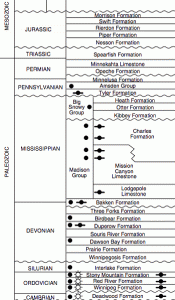
Williston Basin Strat Column

Marathon Oil is drilling a horizontal well in the Tyler formation in Slope County this month.

The formation has produced from vertical wells for years and is comparable to the Bakken from a geology perspective. Both plays include a limestone formation sandwiched by shales.

Marathon has a four well development plan approved and believes the wells could yield an average of 400,000 boe each. That's comparable to Bakken production rates.

It's very early, but watch for additional announcements. It might be a while before we get well results, but Marathon and possibly others will expand their testing plans if the wells prove successful.

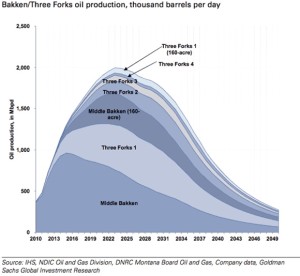
Lynn Helms Thinks Bakken Production Will Double By 2017

Bakken Production Chart - Goldman Sachs

In an address to local officials, the North Dakota Department of Mineral Resources Director, Lynn Helms, shared a belief that the state's oil production will grow to 1.6 million barrels per day by 2017.

That's almost double current production and would represent an annual increase of ~175,000 b/d per year. This is just the latest of several bullish comments from analyst and regulators related to Bakken production growth.

Helms also discussed the need for freshwater in well maintenance activity, water recycling, the need to address flaring, and exploration in the Tyler formation.