Bakken Supports 60,000 Jobs in North Dakota

Bakken Oil Well
Bakken Oil Well

The Bakken and the oil & gas industry as a whole supported 60,000 North Dakota jobs in 2011. The industry also contributed more than $30 billion to the economy in the same year.

The study was conducted by ND State University.

North Dakota Petroleum Council President Ron Ness. "The benefits are broad-based and state-wide. Our booming agriculture and oil and gas industries are stimulating our rural economies and job growth in a way that few of us could have anticipated even five years ago."

The main findings of the study include:

  • Total economic impact of $30.4 billion
  • Oil & Gas industry supported 60,000 jobs or 9% of the workforce
  • Contributed $11.6 billion in personal income
  • Generated $2.65 billion in state government revenue
  • Contributed $7.4 billion to state-wide retail sales

The economic impact of ~$30 billion was doubled the impact estimated in 2009 and almost five times the impact the industry had on the state in 2005. Government revenue is up six times and direct employment is up seven times since 2005.

Read the full story HERE

Northern Oil & Gas Grew Bakken Production 95% in 2012

Northern Oil & Gas Bakken Operators

Northern Oil & Gas had an exceptional year in the Bakken. The company grew production 95% or from just under 2 million boe in 2011 to 3.76 million boe in 2012. That equates to daily production of more than 10,000 boe/d in 2012. Production growth was the result of Northern participating in the drilling of 42.8 net wells and bringing 48.3 net wells to production at a cost of $485 million.

Michael Reger, CEO, commented: "2012 was a year of operational transition in the Williston Basin. Throughout the year, drilling costs peaked and abated, wellhead price differentials peaked and subsequently improved to some of the play`s best levels and operators began the transition to pad drilling.

Bakken reserves grew 44% to 67.6 million boe in 2012. Approximately 55% are classified as proved and undeveloped

The company realized an average oil price differential of $9.79 per barrel in 2012, which compares to $6.30 in 2011. Differentials are expected to trend lower in 2013 as WTI prices trade lower than current Bakken markets that can be reached by rail on the East Coast and West Coast.

[ic-r]Northern held approximately 179,131 net acres in the Williston Basin as of year-end 2012. That total grew during the year as the company spent $37 million acquiring acreage:

  • 17,590 net mineral acres at a cost of $1,788 per acre- $31.5 million
  • 3,404 net mineral acres at a cost of $1,082 per acre - $3.7 million
  • As well as earning 6,450 net acres through farm-ins.

An estimated 64% of the company's acreage is held by production.

2013 Bakken Capital Budget

Northern plans to spend between $420-440 million in 2013. Approximately $370-390 will be spent on drilling and completing wells and an estimated $20 million will be spent on acreage acquisitions. Plans call for the drilling and completion of 44 net Bakken and Three Forks wells.

Production is expected to grow 3,000 boe/d to 4.7-5 million boe for the year. The benefits of multi-pad drilling are expected to be realized in the second half of 2013.

Bakken Production Points To Future World Growth - BP's Dudley

Bob Dudley BP
Bob Dudley BP

BP's Bob Dudley addressed the crowd at IHS CERAWeek to share expectations of what he deemed "challenging opportunities" in the oil and gas industry. His points of emphasis were growth in both North America and Russia. He highlighted "spectacular" growth here in the US.

BP's CEO Bob Dudley stated "Gas production will be the fastest growing fossil fuel at 2% annually. Oil will grow more slowly......But that still means the world will need around 16 million barrels per day more in 2030 than today....that increase alone is nearly the combined daily 2011 production of Russia, Canada, and the UAE"

Non-fossil energy will grow faster as a group, but will still only account for 1/5th of all energy in 2030. To no surprise, BP has a view that oil and gas are here to stay. Oil production needs to grow substantially through the next two decades and shale plays like the Bakken will fill the void.

Notes from Dudley's speech include:

  • US oil production is above 7 mmbbls/d, from 5 mmbbls/d in 2008
  • Both the Gulf of Mexico and Alaska are producing longer and more than thought
  • ND has grown from 100,000 b/d of oil in 2006 to over 750,00 b/d at year-end 2012
  • ND production surpassed Alaska for #2 in the US and now produces more than OPEC member Ecuador
  • US has been successful due to privatized mineral rights and incentives for entrepreneurs
  • Oil & gas employment has risen 27% in the US since 2008 "It is a great renaissance"
  • Import dependence is falling
  • BP spent 35 years attempting to make solar work and was never able to turn a profit

Follow us on twitter @BakkenShaleNews for live updates from the conference.

Top 10 Bakken Operators - December 2012

Bakken Shale Operated Production Dec 2012

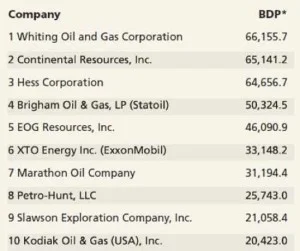
The top ten Bakken operators ranked by gross operated production include the normal list of companies. Whiting Petroleum edged out Continental Resources by a mere 15 b/d to claim top operated in December of 2012:

  1. Whiting Petroleum
  2. Continental Resources
  3. Hess
  4. Statoil
  5. EOG Resources
  6. ExxonMobil (XTO)
  7. Marathon Oil
  8. Petro-Hunt
  9. Slawson Exploration
  10. Kodiak Oil & Gas

Whiting Petroleum #1 Operated Bakken Producer in December

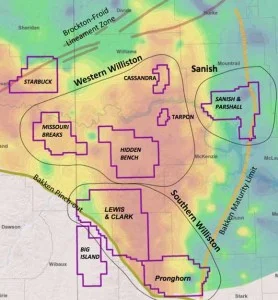
Whiting Bakken Map
Whiting Bakken Map

Whiting Petroleum's operated Bakken production of ~66,156 b/d was higher than any other North Dakota company in December of 2012. Whiting edged out Continental Resources by less than 15 b/d. For operated and non-operated production during the quarter, Continental averaged 67,522 boe/d net in the Bakken to Whiting's ~63,000 boe/d across all of the Rockies (primarily Bakken).

Proved reserves grew in step with production. Whiting had over 378 million boe of proved reserves at the end of 2012, with 165.1 mmboe attributable to the Northern Rockies. Production and reserves growth was the direct result of the company's aggressive spending. The company completed 192.9 net wells in 2012 after only planning for 160 net wells. The company spent a total of $2.1 billion in 2012 and plans to spend $2.2 billion in 2013. Approximately 52% or $1.1 billion will be spent in the Northern Rockies (Bakken) region.

Whiting's Bakken Well Production Improves in 2012

The average Bakken well in the region averaged 572 b/d, 470 b/d and 403 b/d over 30, 60, and 90 day initial production periods in 2012. That's an increase from 432 b/d, 373 b/d, and 338 b/d over 30, 60, and 90 day periods in 2011. That's an improvement over almost 100 b/d over all three periods.

2013 will be spent further proving prospects and downspacing across the basin. Whiting has significant exploratory and development plans across all of its prospects:

  • Pronghorn Prospect - Planning six wells per 1,280-acre spacing unit, up from three
  • Tarpon Prospect - Drilling three well pads
  • Hidden Bench Prospect - Testing the "Middle Bakken Silt" this year and hopes to establish a third productive zone
  • Missouri Breaks Prospect - Continue to de-risk acreage in 2013
  • Sanish Field - 32,590 boe/d net in Q4 2012. Planning a tighter spacing test in early 2013 and refracking wells
  • Rid River - Completing seismic study at the Starbuck prospect and expect $3-3.5 million vertical wells to have EURs of 200,000-300,000 boe at Big Island

The Robinson Lake Plant was processing 67 mmcfd and the Belfield Gas Plant was processing18 mmcfd at year-end.

Read the company's full release at whiting.com