Continental's Bakken Production Soars - Oil Prices Improved

Continental Resources Bakken Production Chart

Continental Resource's Bakken story keeps getting better and better.

The company reported fourth quarter and full-year 2012 earnings with news of soaring production, falling well costs, and better oil price expectations.

Continental's Bakken Production Continues to Outperform

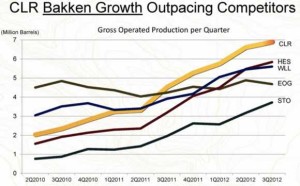
Continental Resources' Bakken production grew 64% from the fourth quarter of 2011 to the fourth quarter 2012 average of 67,522 boe/d. The Bakken and Three Forks now account for over 63% of company-wide production. Continental drilled a total of 259 gross wells with 21 rigs running in 2012. Operations drove proved reserve estimates to 564 million boe at the end of 2012. That's almost double what was booked at year-end 2011 and is what drove us to ask Will Continental's Reserves Cross 1 Billion boe in 2013?

Company operated wells averaged initial production rates of 1,187 boe/d in in North Dakota and 655 boe/d in Montana in the fourth quarter of 2012. Those results fall in line with the company's EUR estimates of 603,000 boe in ND and 430,000 boe in MT.

The second bench of the Three Forks yielded yet another impressive well. The Angus 1-9H flowed at 1,556 boe/d at 3,200 psi in a one day test period.

Bakken Well Costs Are Falling

Continental is entering full development mode on much of its acreage and is pushing operational efficiencies. The most recent improvements in cost are the result of faster cycle times, lower completion costs per stage, and pad drilling. Continental improved its per rig performance to 12 wells per rig in 2012. That's up from just seven wells per rig in 2011.

The most recent six well pad, named the Florida-Alpha project, was completed for $46.8 million or $7.8 million per well. That's well below the company's year-end 2013 target well costs.

Mr. Bott said. "Pad drilling is the future for full-field development, and, given our transition to more pads, we are on track to meet our goal of reducing average operated well costs in the Bakken to $8.2 million per well by year-end 2013, a reduction of $1 million per well in early 2012."

Bakken Oil Prices Are Improving

Continental's oil price differential to NYMEX prices decreased to $3.24/bbl in the fourth quarter of 2012.

Rick Bott, COO, stated, "We now expect average oil differentials in 2013 will be $5 to $7 per barrel....2012 saw fundamental changes in U.S. oil markets, with Bakken crude shipped directly to all major U.S. refining centers and making progress, we believe, toward becoming a national benchmark crude," he said. "Refiners on the East, Gulf and West coasts value the consistently high quality of sweet Bakken crude and the fact that supply from the basin continues to grow.

The expectation for differentials that average just $5-7/bbl is a sharp improvement from prior guidance of $8-11/bbl.

Read the full press release at contres.com

SM Energy Begins Bakken Infill Drilling - Moving to Walking Rigs

SM Energy Bakken Map

SM Energy grew company wide production by 18% from the fourth quarter of 2011 to 2012. Strong growth was the direct result of successful development in both the Bakken (40% growth) and Eagle Ford (50% growth).

During 2012, SM completed 30 operated wells, with focus in the Bear Den, Raven, and Gooseneck prospects noted in the map. In 2013, drilling will shift almost completely to infill drilling in those areas. Exploration is complete and the company can begin pushing to improve operational efficiencies by employing walking rigs on multi-well pads. Two traditional rigs will be exchanged for walking rigs in early 2013.

Tony Best, CEO, remarked, "SM Energy had a record-breaking year in 2012 with new highs for proved reserves and annual production, completing the year with record quarterly production. These results were driven by our high rate of return oil and liquid-rich programs in the Eagle Ford shale and Bakken/Three Forks, which are expected to continue to drive our growth in 2013."

SM Energy produced 11,900 boe/d from the Bakken in the fourth quarter of 2012 and increased proved reserves in the Rockies from 48.4 to 54.8 mmboe during the year.

The company also sold non-operated Bakken acreage as the year ended. In total, SM divested 27,000 net acres, with 6,000 net acres located in the company's focus area.

SM now has:

  • 162,000 net acres prospective for the Bakken and Three Forks Formations
  • 81,000 net acres located in the company's focus area

Read the company's full press release at sm-energy.com

Kodiak Oil & Gas Grows Bakken Reserves 138%

Kodiak Bakken Acreage Map

Kodiak Oil & Gas ended 2012 with 94.8 mmboe of proved reserves (85% oil) in the Williston Basin. That's up 138% from 39.8 mmboe at year-end 2011. Just under half of the company's reserves (46%) are proved, developed, and producing (PDP). Production is expected to grow to 29,000-31,000 boe/d in 2013. That's almost double the ~15,000 boe/d the company produced in 2012 (18,200 boe/d in Q4).

Kodiak spent $810 million developing the Bakken in 2012. Guidance for the year was $738 million, but the company spent more as drilling efficiencies allowed more wells to be drilled and good weather allowed for more activity in the fourth quarter. Kodiak has planned to spend $775 million in 2013 - $740 million for drilling and completing wells, along with $35 million for waste water disposal, well connections, and acreage acquisitions.

The company plans to continue operating seven rigs going forward. Four rigs are operating in Williams County, two in McKenzie County, and one in Dunn County. The company also employs two dedicated frack crews.

Two tests are also underway where the company will drill 12 wells in one 1,280-acre spacing unit. One unit is located in the Polar area and one in the Smokey area (see map above).

The company will also expand drilling in the Three Forks:

Kodiak's Chairman and CEO Lynn Peterson said: "Regarding the TFS, we believe the multiple intervals of TFS appear to exist only through the deeper part of the Williston Basin where the TFS is thicker and more thermally mature. We continue to view the TFS as a single hydrocarbon system. Based upon our fracture stimulation analysis, we believe that the production does communicate between the TFS intervals; however, due to the expanding thickness of the oil saturated reservoir, additional well bores are required to optimize reservoir drainage. We do not believe the lower TFS interval exists throughout our entire acreage block, but that the interval is most likely present in the southern portion of our Polar acreage block and in our Koala and Smokey blocks. The tighter density of well bores in the Middle Bakken will likely be effective only through these same geographic areas as well as in our Dunn County acreage where we continue to achieve strong well results."


Bakken Production Sets Record - Surpasses 700,000 b/d

Bakken Production and Oil Price

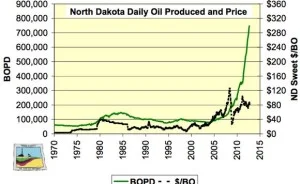
Bakken oil production hit a new record in December of 2012, after declining in November for the first time in almost two years. Weather related delays kept operators from pushing through old records in November, but production surged to more than 700,000 b/d in December.

The state reported Bakken production of 21,835,148 barrels or 704,360 barrels per day in December. The region also eclipsed the 5,000 producing well mark during the month. 5,044 wells produced an average of almost 140 b/d.

Opportunities in the Bakken - Houston Event

Houston Skyline
Houston Skyline

If you're located in Texas, there's a Bakken Event on February 21st at the Sheraton. Speakers will address the why, how, and the future of North Dakota. You'll learn why the state has the lowest unemployment rate in the US and hear more about business opportunities in the region.

The lineup of speakers includes reps from the several companies active in the Bakken.