Hess Increases Bakken Production Guidance Through 2020

Hess Corp. Bakken Spacing Pilot

Hess Corp., one of the top five Bakken producers, appears to be undeterred by lower oil prices, announcing plans to increase its five year production forecast this week.

After a successful Bakken downspacing pilot program in 2014, Hess told investors it would increase its net peak production guidance in the play to ~175,000 boe/d by 2020. The increase means the company would add an additional 1,000 well locations to a total of more than 4,000.

Even at current prices, or below, there’s still many areas for attractive investment in the Bakken,” said CEO John Hess the company’s annual investor day on Monday.

Hess told investors that he believes prices will rebound, and also pointed to drilling efficiency gains made in the Bakken that reduce the cost of drilling a Bakken well.

Hess' Tioga Gas Plant Expansion Project Paying Off

At the beginning of the year, poor weather conditions delayed work on Hess' Tioga gas plant expansion project, negatively impacting Bakken production in the first-quarter. By the second-quarter, production returned to expected levels, and at the end of the third-quarter production from the Bakken increased 21% year-over-year to 86,000 boe/d, due in part to the completion of the expansion project.

Read more:Hess Production To Soar in the Bakken By the End of 2014

Hess' Q3 Bakken Operations

Hess brought 59 gross operated wells on production in the third-quarter, bringing the year-to-date total to 142 wells. Drilling and completion costs per operated well averaged $7.2 million in the third-quarter of 2014, a reduction of 8% from the third-quarter of 2013.

Read more at hess.com
Emerald Oil May Scale Back Bakken Drilling Program in Q1 2015

Emerald Oil Bakken Acreage Map

Emerald Oil, Inc. could cut its Bakken drilling program the first quarter of next year if the price of oil continues to drop. Emerald's CEO McAndrew Rudisill announced the company's plans in a conference call for investors this week.

With WTI now below $80, we could see the first shoes begin to drop among some Bakken producers. According to the consultancy Wood Mackenzie, breakeven oil prices range from $60 to $80 per barrel in North Dakota's Bakken.

Emerald's current three-rig drilling program is slated to continue in the Bakken through the end of the year, but the contract for one of its rigs expires in the first quarter of next year (March 15, 2015), and the company may not renew it.

According to Rudisill, the company’s decision will be determined largely by what is happening with WTI crude oil price.”We have to respond to large changes in the price of crude oil, said Rudisill. We will make a decision in the middle of March 2015 on whether or not to lay down the third rig.

During the third-quarter of 2014, Emerald increased its production 3% quarter-on-quarter to 3,855 boe/d, and during the fourth-quarter, the company expects to produce 4,300 boe/d. The company missed its production guidance for the third quarter by 8%, citing mandated North Dakota road shutdowns due to poor weather conditions. Guidance was also reduced 6.5% for the fourth-quarter because of down-time expected from artificial lift installations, which were originally scheduled for the third quarter.

Emerald's capital budget for 2015 is $210 - $240-million.

Read more at emeraldoil.com

Magnum Hunter Sells Bakken Acreage - $84.7-Million

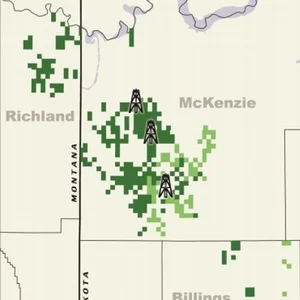
Magnum Hunter Resources' Bakken Acreage Map

Houston, TX-based Magnum Hunter Resources has sold a large chunk of its Bakken acreage for $84.7-million to an undisclosed buyer.

The deal, which closed in mid October of this year, included non-operated working interests in ~105,661 gross (12,500 net) leasehold acres in Divide County, ND. The divested properties currently account for net average production of ~720 boe/d.

In a prepared statement, CEO Gary Evans described the sold Bakken assets as non-core. “Our remaining portfolio of assets located in North Dakota consists of 151 gross producing wells covering approximately 159,916 gross (73,690 net) acres, said Evans. Total net production to the Company from these remaining assets is currently approximately 2,577 boe/d at present with another ~800 boe/d anticipated to be put on production prior to year-end from this region.

According to company officials, total divestitures, including this one, have amounted to $210-million across Magnum Hunter's portfolio so far in 2014. In the second quarter of 2013, the company sold 19,000 net acres in the Eagle Ford to Penn Virginia for approximately $400-million. The deal was for the majority of the company’s Eagle Ford holdings.

Read more: Magnum Hunter Resources Completes Sale to PVA - Still Targeting Eagle Ford & Pearsall

Magnum Hunter's divestment strategy is designed to shift the company's focus to growth in the Marcellus Shale and Utica Shale in West Virginia and Ohio.

Continental Resource's Harold Hamm on Falling Oil Prices - Videos

Continental Resources, the Bakken's second largest producer, will not change its course on new drilling immediately due to falling oil prices, according to its CEO Harold Hamm. In a Platt's Energy Week interview on Sunday, Hamm said prices would have to fall another 20% before Continental would significantly cut back its operations. Hamm has been making the rounds on TV, also appearing on CNBC, talking about what he believes are some of the reasons behind the drop in oil prices. Hamm points the finger sharply at OPEC, accusing the Saudi's of using rhetoric to dictate price.

Since June of this year, oil prices have been falling, and the reasons why have to do with supply v. demand. The shale oil boom, for instance, has increased the supply of oil worldwide, and demand has gone down in China, the world's second largest oil consumer. But the main reason oil prices have dropped can be traced back to OPEC, which has for all intents and purposes allowed the price of oil to drop, by actively engaging in talks of opposing cuts to production to curb supply.

Hamm doesn't believe the Saudi's have the power to set oil prices, but the fact remains OPEC controls 81% of the world's crude oil reserves. According to the Wall Street Journal (WSJ), which cited sources familiar with the matter, OPEC will oppose any cuts to it's oil production ceiling., in its late November meeting in Vienna.

See  Harold Hamm interview:

Platt's Energy Week Interview - 10/26/14

Bakken Study Analyzes Impact of Oil Prices on Development

Bakken Well Recovery Costs Graph

Bismarck, ND-based KLJ Engineering recently completed a study commissioned by the North Dakota legislature to provide decision makers with data about the Bakken's potential economic impact on the state through 2019.

The full KLJ report, released in September of 2014, focused on 19 oil & gas producing counties in North Dakota, and incorporated three approaches to forecast the sustainability of oil and gas production:

  • Economic analysis of the Bakken and Three Forks formation
  • Projections of population, employment and housing needs
  • Potential for CO2 enhanced oil recovery (EOR)

Of particular interest to industry is the impact of falling oil prices on future development. Earlier this month, Lynn Helms, the Dir. of North Dakota's Department of Mineral Resources (DMR), said two things could hurt production: low oil prices and new flaring regulations.

Read more: Bakken Development Threats on the Horizon

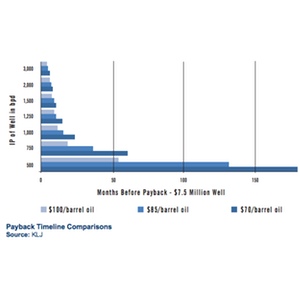
The KLJ study provided some interesting insight into how oil prices would impact production based on (IP) rates. In the core areas for development (McKenzie, Williams, Mountrail and Dunn Counties) most wells are well above 1,000 b/d, but on the fringes of these core areas, IP rates tend to be lower.

According to the study, at the $70 per barrel price, a well IP of 500 b/d would never recover its costs. In order to recover well costs within 5 years, a 500 b/d IP well would need oil prices to exceed $100 per barrel. In stark contrast, modeling sensitivity scenarios such as large drops in prices down to $35 per barrel with high IP wells, which are common in parts of the Bakken/Three Forks, still have positive economic returns. Based on modeling outputs, IPs of 500 b/d or less will not be attractive to companies if well costs equal $7.5 million, and oil prices are in the vicinity of the 2014 average price of $85 per barrel. Conversely wells in the 500 to 750 bpd IP range are attractive, but susceptible to oil price fluctuations. Wells having at least 1,000 bpd IPs are attractive at current or higher oil prices, and for the most part, will still be attractive even with a reduction in oil prices. In discussions with industry representatives, companies generally expect to recover costs in three years or less, and a five-year payback time frame would be acceptable only in very unusual circumstances.

BakkenShale.com will provide additional details and commentary centered around the KLJ study in future posts.