Oil & Gas Industry Focused on Innovation - Deloitte Oil & Gas Conference

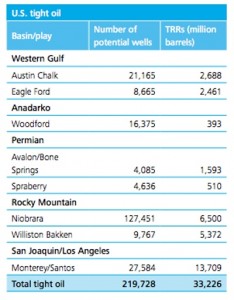
Deloitte - Technically Recoverable Tight Oil

Several key leaders from across the industry shared their optimism at the annual Deloitte Oil & Gas Conference on November 16th.

The conference agenda covers the global oil & gas industry, but US shale plays dominated the conference. Many of the speakers reiterated that we're no longer in a "shale revolution", but a renaissance that will last for years to come.

The industry is focused on innovation. New technologies are needed to address challenges presented in shale development. Whether it is lowering operating costs or utilizing currently flared gas through a gas-to-liquids (GTL) process, the industry sees room for growth.

A few key points and statistics we noted while at the conference:

  • Oil production has grown to 1980s levels
  • 15% of technically recoverable shale gas and 17% of technically recoverable shale oil resources globally are located in the US
  • The US will pass Russia as leading O&G producer this year; will pass Saudi Arabia next year
  • Shale has increased our current trade balance by $200 million/yr and is predicted to give us oil independence by 2020
  • US has increasing geopolitical influence in critical regions due to growing oil & gas production
  • The oil export ban needs reform. Otherwise, refinery changes are needed and we will consume more expensive crude.
  • Operators are focused on cutting costs to increase valuations
  • According to Maynard Holt, "we may be in the 8th inning of the shale game, but we're in the 3rd inning of the completion/cocktail game"
  • Since 2008, foreign firms have invested over $100 billion in US unconventional assets
  • Over that period, Chinese companies have spent $44 billion to acquire N. America based energy firms and assets
  • Gas-to-liquids technology is becoming more and more attractive with current oil and gas prices
  • Skip Horvath, Natural Gas Supply Association predicts that natural gas will hit $6.00 by 2020, "assuming Washington leaves us alone over the next few years."

"This boom isn't just for a few years. We believe the shale revolution really has staying power" -Ryan Lance, ConocoPhillips CEO

About the Deloitte Oil & Gas Conference

The Deloitte Oil & Gas Conference is an annual conference for oil and gas executives and leading industry experts to share their views on important issues facing the global oil and gas industry. The objective of this conference is to provide a forum for executives and managers from companies in all sectors of the oil and gas industry, commercial and investment bankers, industry analysts, service providers to the oil and gas industry, representatives of government agencies, trade groups and policy planners, to understand emerging issues.
Bakken Regional Rig Count 176 - Oneok Annouces More Investments - Nov 22, 2013

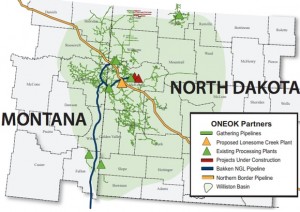
Oneok North Dakota Bakken Asset Map

The Bakken rig count increased by two rigs to 176 running last week.

News was highlighted by an announcement from Oneok that the company willspend an additional ~$650-780 million expanding midstream infrastructure in the region. Oneok plans to expand its' Bakken NGL Pipeline, add gathering and compression, and build a seventh NGL processing plant (its largest to date). Read more in the article: Oneok Investing More In Bakken Midstream Infrastructure

The U.S. rig count decreased 1 rig from 1,762 to 1,761 running over the past week. A total of 369 rigs are targeting natural gas (1 less than last week) and 1,387 (2 more than last week) are targeting oil in the U.S. The remainder are drilling service wells (e.g. disposal wells, injection wells, etc.). 179 (up 2 from last week) rigs are running in the Williston Basin across MT, ND, and SD.

Not all rigs counted in our census are drilling for the Bakken, but it's close. The NDIC estimates 95% or more of activity in this region targets the Bakken and Three Forks formations.

Note: The NDIC reports 187 rigs are active in North Dakota. That is 21 more than Baker Hughes reports in the Bakken area. The difference is likely accounted for in the number of rigs actually working, rigs that might not be serviced by Baker Hughes AND areas outside of the Bakken fairway. On any given week, a certain number of rigs are in route to the next well location or idle waiting to drill the next well. The NDIC notes that more than 10 rigs are in the process of moving in and rigging up.

Bakken Oil & Gas Rigs

[ic-l]The number of oil rigs running increased by two to 176. WTI oil prices were trading near $95/bbl to end the week. Williston Basin Sweet crude traded at $76.44/bbl as of Nov 22nd. The WTI-Brent spread continues to widen, widening to over $15 as of Nov 18, which should continue to spur the growth of crude by rail.

The natural gas rig count in the region held flat at zero. Natural gas futures (Henry Hub) were trading near $3.75/mmbtu on Friday. Natural gas delivered to the Northern Border pipeline in Watford City is trading near $3.00/mmbtu. A little more than 10% of the production stream from the Bakken and Three Forks is attributable to natural gas

McKenzie County continues to lead development with 60 rigs running. Dunn, Mountrail, and Williams counties are the only other counties with more than 20 rigs running. View the full list below.

Activity is dominated by horizontal drilling: 155 rigs are drilling horizontal wells, 15 rigs are drilling directional wells, and 6 rigs are drilling vertical wells.

Bakken Oil & Gas News

Be sure to visit our Bakken Job Listings to search openings and come back weekly for updates.

Bakken Drilling by County

What is the Rig Count?

The Bakken Shale Rig Count is an index of the total number of oil & gas drilling rigs running across Montana and North Dakota. The rigs referred to in this article are for ALL drilling reported by Baker Hughes and not solely wells targeting the Bakken formation. All land rigs and onshore rig data shown here are based upon industry estimates provided by the Baker Hughes Rig Count and/or Smith Service Co's (Schlumberger) Smith Rig Count.

ND Oil Production On Pace for More than 1 Million b/d by Year-end

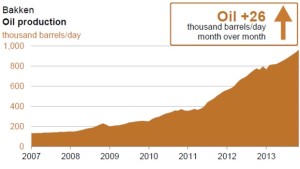
EIA Bakken Oil Graph Oct 2013

North Dakota oil production is on pace to eclipse 1 million b/d by year-end. The state reported production of ~932,000 b/d in September and is expected to add between 20,000 and 30,000 b/d each month going forward.

ND natural gas production set a new record at 1.06 bcf/d.

The state should also eclipse 10,000 producing wells before year-end. The real risk to any of the above trends is snow and cold weather.

Other takeaways include:

  • 207 wells were completed in September - up from 153 in August
  • One well is getting completed for every 1.5 drilled
  • Time from spud to first production held at ~100 days
  • >95% of drilling targets the Bakken and Three Forks
  • Natural gas prices near Watford City are trading near $3/mcf

Read the full director's cut at dmr.nd.gov

Is the Bakken Boom Getting Boomier? - Video

An Irish correspondent visited North Dakota and he believes the Bakken boom is getting boomier. It's a good overview of what's happening from a foreign perspective. Enjoy the Irish commentary:

A few interesting quotes and takeaways:

  • The Bakken covers an area twice the size of Ireland
  • The population in the region is just half that of the Irish Province Munster
  • Development is the "biggest oil boom on American land since Texas"
  • "Digging" thousands of oil wells
  • Prices are making the boom even more boomier
  • Lucky workers make it to the man camps that beat all man camps
  • Many didn't have much and are now multi-millionaires

P.S. Don't be surprised if you see me use the word "boomier" (pronounced: boomy-er) in the future.

QEP Resources Bakken & Three Forks Production Surpasses 21,000 boe/d

QEP Resources Fort Berthold Bakken Well Results

QEP Resources Bakken and Three Forks production grew a little less than 1,000 boe/d in the third quarter to average 21,300 boe/d.

QEP brought 21 operated wells to production with impressive initial production rates. Ten wells in the South Antelope area came online with a 24-hour initial production (IP) rate of 3,412 boe/d and 11 wells in the Fort Berthold area came online with IPs of 2,588 boe/d. Many of those wells were drilled and completed on mult-well pads.

Production didn't grow quite as much as expected due to midstream bottlenecks and shut-ins required by drilling operations. I suspect we'll see relatively strong growth in the fourth quarter.

At the end of the third quarter, QEP had drilling operations active on eight well pads (3 at South Antelope and 5 at Fort Berthold). QEP also has an interest in 24 outside operated wells being drilled and is awaiting completion on 22 operated and non-operated wells.

In the Williston Basin, we brought on 21 new QEP-operated wells in the third quarter compared to a total of 27 operated completions in the first half of the year. Production results from our South Antelope wells continue to confirm our pre-drill EUR expectations. Despite some delayed well completions — in part due to bottlenecks in third-party downstream crude oil systems — and shut-ins of existing wells for offset completions, we expect to grow oil production at an enviable rate of 60 percent over 2012.
— Chuck Stanley, CEO

On QEP's Fort Berthold acreage alone, the company estimates potential for 420 gross Bakken and Three Forks wells at 160-acre spacing. EURs in the Bakken range from 400-650 mboe and wells in the Three Forks are expected to yield 350-600 mboe. That equates to resource potential of 121-202 million barrels of oil equivalent (net) from QEP's Fort Berthold assets alone.

Read the full press release at qepres.com