Continental Resources' Three Forks Bench Well Results - Bakken Production Up

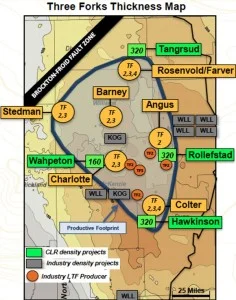
Continental Resources Three Forks Thickness Map

Continental Resources believes its well results and other industry wells prove the lower Three Forks will be prospective over a 3,800 square mile area. A total of eighteen wells have been drilled in the lower Three Forks and the company has only seen interference with other zones in one unit where there is significant natural fracturing (Colter Unit noted on the map).

Bakken production grew to 88,000 boe/d in the second quarter. That's up 14% from the first quarter and up 65% from the second quarter of 2012. Bakken growth supported a full-year production growth projection increase from 35-40% to 38-40%. Continental is running 20 rigs in the Bakken region.

We are extremely pleased with our progress to date on productivity and interference testing in the lower Three Forks benches across a large area. Our industry-leading approach to scientifically understanding the field will allow us to optimize the development of America’s greatest oil play - the Bakken.
— Harold G. Hamm, CEO,

he company participated in the completion of 180 gross (73 net) wells in in the second quarter. The company's backlog of drilled and not yet completed wells stands at 75 wells.

The average well in the North Dakota came online at 1,150 boe/d and wells in Montana came online at 455 boe/d. Three Forks Second Bench and Three Forks Third Bench wells have come online at an average of 1,200 boe/d and 970 boe/d, respectively.

Drilling Faster At Lower Costs

Approximately 70% of Continental's wells are drilled from well pads in the Bakken and spud to total depth has declined by 4 days (20%) compared to one year ago.

Our initial target was to lower our operated well cost by $1 million per well by year-end 2013 to $8.2 million and now we think we can get to $8.0 million or lower per operated well.
— Richard E. Muncrief, VP

The best wells in North Dakota have been drilled at a cost of $7.5 million and the best wells in Montana have been drilled for a cost of $6.4 million.

Read more from the company at contres.com

Marathon Oil's Bakken Drilling Speed Improves 10% In The Second Quarter

Marathon Oil Bakken Map

Marathon Oil averaged 25 days from spud to spud in the first quarter and that time improved to 22 days in the second quarter. The company's spud to total depth for each well fell to 15 days.

Marathon hit total depth on 22 wells and brought 16 wells to production. That compares to 18 wells drilled and 22 wells brought to production in the first quarter.

The company's Bakken production grew 5% from 37,000 boe/d to 39,000 boe/d in the second quarter.

Marathon Oil’s Bakken production averages approximately 90 percent crude oil, 5 percent NGLs and 5 percent natural gas.

The company noted average realized prices in the Bakken of:

  • 88.65/bbl of oil
  • $35.92/bbl of NGLs
  • $4.47/mcf of gas sold

Read the full press release at marathonoil.com

QEP Grows Bakken Production 20% In The Second Quarter

QEP Resources Bakken Three Forks Acreage Map

QEP Resources has grown oil production 82% over the past year and that is largely attributable to assets in the Williston Basin. Bakken and Three Forks production grew to average 20,400 boe/d in the second quarter. That's up from 17,000 boe/d in the first quarter.

QEP drilled and completed 15 wells in the quarter. Nine wells were completed in the Fort Berthold area and six were completed in the South Antelope area.

The company's first well pad in the South Antelope area saw four wells come online at a total of more than 15,000 boe/d.

The second quarter was one of steady progress at QEP,” commented Chuck Stanley, CEO. “We continued to increase activity in the Williston Basin and brought on 15 new operated wells in the quarter. Individual well performance has been in line with or ahead of expectations, and we continue to make progress on lowering well costs.

QEP also participated in 18 non-operated wells. At the end of the quarter, the company had 11 operated wells awaiting completion, 10 non-operated wells being drilled, and 28 non-operated wells awaiting completion. The average working interest in the company's non-operated properties is less than 6%.

QEP Resources has an interest in 116,000 net acres in the region and is running 8 rigs. Development is primarily focused in the Fort Berthold and South Antelope areas.

In the South Antelope area, the company drills 5,000-12,500 ft laterals and expects ultimate recoveries from each well will reach to more than 1 million boe. In the Fort Berthold area, QEP also drills 5,00-12,500 ft laterals and expects ultimate recoveries per well to range from 300,000 to 900,000 boe

Read the company's full press release at qepres.com

Halcon Completes Company Record Bakken Well At Fort Berthold

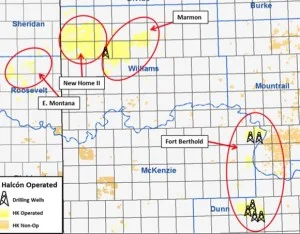
Halcon Resources Bakken Acreage Map

Halcon Resources ran seven rigs and spud 16 wells in the Bakken during the second quarter. A total of ten wells were brought online and new completion methods are proving successful. The average well completed in the Fort Berthold area had an average initial production (IP) rate of more than 2,000 boe/d. Completion rates improved by more than 50% across the area in the quarter.

The two most recent completions came online at more than 3,000 boe/d and a company record was set with an IP of 3,317 boe/d.

Halcon has 150,000 net acres in the Williston and plans to run six rigs through the remainder of the year. The company has 149 Bakken & Three Forks wells producing, 18 wells being completed, and seven wells being drilled.

Halcon expects downspacing tests to provide more details related to effective drainage of the Bakken and Three Forks. The company is also testing the application of slick water fracks across areas of its holdings. Tests are ongoing through 2013.

The company also published higher than expected operating costs due to weather and associated delays in North Dakota during the quarter.

You can read the company's full press release at halconresources.com

SM Energy's Bakken Production Up - Utilizing Walking Rigs

SM Energy Bakken Map

SM Energy's Bakken production was up 12% from the first quarter to average 13,700 boe/d in the second quarter of 2013.

During the quarter, the company released two traditional rigs and contracted a walking rig. SM plans to run three rigs through 2013. Almost all activity is infill drilling at this point. SM is has largely completed its exploration efforts and its efforts to hold leases with production.

Pad drilling has driven costs down 8% on the company's Gooseneck acreage to an average of $6.5 million.

SM completed 12 gross Bakken wells in the second quarter and expects to complete 40 gross wells in 2013.

Watch for results from a downspacing pilot and a lower Three Forks test in the Raven area. Other operators have also had success in the Bakken interval in the Gooseneck area. Positive results from any of those could add to the company's resource potential.

Read the company's full second quarter press release at sm-energy.com