Exxon's Bakken Production Up 75% - Running Ten Rigs

Exxon North America Play Map

ExxonMobil's Bakken production is up 75% from a year ago and the company is running ten rigs across the area.

Exxon's XTO subsidiary operates the more than 585,000 net acres prospective for the Bakken.

The company has also fully integrated the assets that were purchased from Denbury late last year. Read more about the deal in the article Denbury - Exxon Deal Includes Bakken Acreage and CO2 Assets


Hess Bakken Production Jumps & Well Costs Fall

Hess Bakken Map
Hess Bakken Map

Hess reported Bakken production of 65,000 boe/d in the first quarter of 2013. That represents 55% growth from the first quarter of 2012 and sets the company up well to meet its 2013 guidance of 64,000-70,000 boe/d.

Production will remain relatively flat in the second quarter as the company completes its transition to pad drilling.

A total of 30 wells were completed in the first quarter, but that number will grow throughout the year as the company plans to complete 175 wells by year-end. Approximately two-thirds will be completed in the Bakken and one-third will be completed in the Three Forks.

Hess completed 10 of the 25 best Bakken wells in North Dakota in 2012. Production growth and well completions will be weighted to the second half of the year. Hess is well on its way to its target of 120,000 boe/d by 2015.

The company also commented that down spacing test at 160-acres have been positive, but that it is very clear you will down space that far in some areas and not in others. Also, well results in the first quarter project EURs in the low 600,000 boe per well

Bakken Well Costs Coming Down For Hess

[ic-r]Well costs have also improved significantly from one year ago. Well costs averaged just $8.6 million in the first quarter, down 36% from $13.4 million in the first quarter 2012. Costs are expected to continue falling as pad drilling is implemented across a wider area the next two quarters.

The Tioga Rail Facility ran at capacity in the first quarter (53,000 b/d) and the Tioga Gas Plant expansion is on schedule to be completed by year-end.

Whiting Petroleum Hits Record Production Levels In Q1 2013

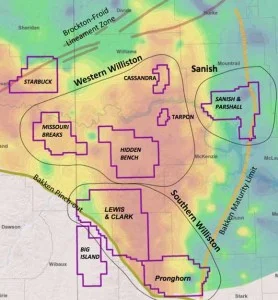
Whiting Bakken Map
Whiting Bakken Map

Whiting Petroleum reported record company-wide production in the first quarter of 2013 of more than 8 million boe (over 89,000 boe/d).

That represents 4% growth over Q4 2012 and 10% growth over Q1 2012.

The growth was driven by the company's assets in the Western Williston, Southern Williston, and Sanish Field areas. Seismic work completed at the Starbuck prospect and positive results from the Niobrara Shale mean Whiting could have future growth not baked into its guidance of 12-16% in 2013.

In the Williston Basin, drilling at our Sanish, Pronghorn, Hidden Bench and Tarpon fields continues to underpin our production increases. Recent well results at our Missouri Breaks prospect indicate that this area should also contribute significantly to future production growth.
— Mr. Volker, CEO

Bakken Highlights

  • Western Williston Basin production grew 27% from Q4 to 6,520 boe/d
  • A well was brought online at almost 1,500 boe/d in the Missouri Breaks prospect
  • South Williston production grew 52% from Q1 2012 to 13,800 boe/d
  • Sanish production grew 16% from Q1 2012 to more than 33,000 boe/d
  • Big Island Prospect yielded two vertical Red River wells that produced more than 200 boe/d
  • Completed 3-D seismic on the Starbuck prospect.

Whiting also completed a successful well in the Niobrara in the Denver-Julesberg Basin. The Razor 26-3524H flowed over 861 boe/d intially. One rig is working the area an another will be added at mid-year.

The company operates a total 23 rigs and ~20 of those are active in the Williston Basin.

Read the full press release at whiting.com

Newfield Completes Record Bakken Wells

Newfield Bakken Acreage Map

Newfield reported first quarter earnings and along with financial results the company reported company record wells in the Bakken.

Wells completed in the Bakken produced more than 3,100 boe/d and wells completed in the Three Forks yielded more than 2,400 boe/d. The impressive production rates drove Bakken production growth estimates from 15% to 25% in 2013.

Our production in the first quarter of 2013 exceeded our beginning of the year expectations and we are ‘on target’ to deliver on our expected 39% growth in domestic liquids volumes for the year (adjusted for asset sales in 2012),” said Lee K. Boothby, Newfield CEO. “We kicked off the year with better than expected first quarter volumes in our Cana Woodford, Williston and Uinta Basin operating regions and posted quarter-over-quarter production growth in our domestic operating regions.

Newfield posted cost improvements and production growth across many of its core areas of development. Costs are down in the Eagle Ford and record drilling times were achieved in the Uinta Basin in Utah.

Read more at newfield.com

Slower Bakken Production Growth in 2013 - Core Labs

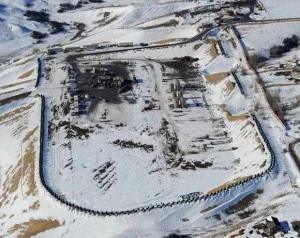
Bakken Well Pad
Bakken Well Pad

Core Labs' CEO, David Demshur, expressed a belief that the Bakken will grow slower in 2013 on a conference call this past week. He noted the rig count has been down five consecutive months and that production growth has slowed compared to earlier in 2012.

At the peak of growth last year, production was growing by more than 20,000 b/d each month. That has since slowed to just 53,000 b/d of growth over the past five months (almost 50% less).

Mr. Demshur commented, "so the moderation in the rig count probably is going to lead to lower production or gross production gain within the Bakken. Keep in mind that the decline rate first year block in production is about 40%, second year about 25%."

While I believe Mr. Demshur's comments are largely correct, there are a few reasons we can not rely on them solely.

  1. Companies ramped up development this past year as crude-by-rail facilities allowed them to realize better prices than ever before. That gave incentive to push the production barrier more than one might in a constrained pipeline environment. Essentially, production grew fast than what should be considered "normal"
  2. Operators are moving to pad drilling, so production will come online in a less consistent, more choppy manner. Multiple wells will come on at once versus just one at a time previously.
  3. Production growth always slows in the winter. It gets cold in North Dakota and operations are more difficult. Read more in the post Bakken Production Down, But Not Out in November
He also stated “We’ve gone on record saying we’ll take the under on 1.5 million b/d production projections in 2014.

Read the company's quarterly call transcript at seekingalpha.com