Merry Christmas
Merry Christmas from BakkenShale.com.

Your Custom Text Here

Merry Christmas from BakkenShale.com.

Continental Resources (CLR) has reached an agreement to pay $649 million for almost 120,000 acres, primarily in Williams and Divide counties, from Samson Resources. The deal expands Continental's dominant Bakken position to more than 1.1 million acres!
The deal includes 6,500 boe/d of production (82% oil) and was announced in conjunction with the sale of assets in the company's Eastern Region. The sale included 1,100 boe/d of production and raised $125 million.
“Continental believes the entire acquisition area.....has potential for deeper Three Forks development, based on three strategically placed cores taken in 2011. ”
The Bakken acquisition includes over 45,000 net acres where Samson and Continental were already partners. CLR's interest in the assets increased to 71% from 46%. Almost 35,000 net acres are already held by production from existing wells. Continental has a lower working interest (34%) in the rest of the acreage acquired, but will operate the bulk of the wells in the area. Of the remaining ~74,000 acres, almost 30,o00 is held by production from existing wells.
It is becoming more apparent that Continental believes economy of scale is going to add value to their bottom line. Bigger operators have more negotiating power in everything in the supply chain all the way to the midstream and downstream markets. Plans to expand ECO-Pad drilling across the basin also adds motive to consolidate fragmented interest across the basin. If invested all the capital, research and technical expertise in drilling multiple wells on location at one time, you'd want to benefit from operational success as much as possible. There's no sense in doing the dirty work for passive partners when they are willing sellers.
"This is a classic bolt-on acquisition, from a number of perspectives - strategic, tactical and financial," said Rick Bott, President and Chief Operating Officer. "It fits nicely into our deeper bench Three Forks de-risking plan, and we expect it to add immediate value. Within the next 30 days we plan to spud the first of 10 wells in the northern region, targeting the deeper benches to confirm commercial production and appraise our down-spacing concept, so we can quickly leverage operational efficiencies with pad drilling."
Read the full press release at contres.com
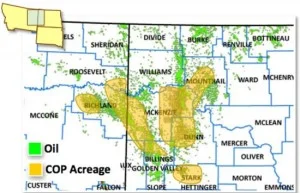
ConocoPhillips released plans to spend $15.8 billion in 2013. Of that, more $4 billion will be spent across the company's U.S. assets in the Bakken, Barnett, Eagle Ford, Niobrara, and Permian Basin areas. Targets in all of those areas are liquids-rich.
If 2012 is a good indication of what to expect in 2013, Conoco will likely spend 15-20% of the $4 billion allocated for the U.S. in the Bakken. In 2012, the company spent approximately $600 million developing the play.
Conoco's believes its 600,000 + acres in the Bakken will yield:
Read the full press release at conocophillips.com

Bakken crude can realize premium prices by moving west. The only problem is there isn't much receipt capacity. Long distances, very little pipeline capacity, and limited rail mean it's hard to move crude West out of ND. Recent estimates show more than 40,000 b/d of Bakken crude is being transported to Washington, but only a few thousand barrels per day is making its way south into California. That's a problem. West Coast refineries are paying over $105 per barrel for Alaskan crude, while oil in North Dakota is trading for as little as $80 per barrel.
Assuming it would cost $15 per barrel to move crude by rail to Southern California, those looking to profit stand to make $10+ per barrel based on current spreads. That's more than enough incentive for refineries and midstream companies, but its easier said than done.
"It's entirely possible California refiners decide they can't get this done in time to catch the arbitrage, so refiners wouldn't get the benefit of low-cost crude from the Midcontinent," said David Hackett, president of energy consultancy Stillwater Associates.
East Coast and Gulf Coast refiners are enjoying some of the best margins in the world, but on the West Coast, refiners are missing the party. If significant rail receipt capacity isn't built or pipelines converted to oil, refineries might miss out on the benefits of the current domestic oil boom all together.
Tesoro mentioned two relevant measures at its analyst day in early December 2012:
Bakken crude can help with first issue, but they're going to have to get the state on their side to make advances with the second issue. Coming off a recent $2.5 billion acquisition of the Carson Refinery from BP, Tesoro has plenty at stake and I don't expect they'll let the current oil boom pass them by.

It's no secret North Dakota oil production has been on an amazing growth trajectory. Recent figures show the state set a new production record in September of 2012 with more than 728,000 b/d of oil production. The state is only second to Texas and the two look to be separating themselves from the pack. Alaska and California rank third and fourth in oil production, but neither has a growth engine like the Bakken.
Production in ND has more than doubled in the past two years. Operators have hit their stride in terms of the development, the play has proven to be larger than most expected (multiple horizons and larger area), and pipeline projects and rail agreements are relieving the midstream problems that have plagued the area.
In the most recent infrastructure development, read more about Enbridge's New Sandpiper Project
North Dakota is not alone. Production declines have reversed across the country. The U.S. produced almost 6.5 million b/d in September, the highest level in almost 15 years. You have to go back to September 1997 to find comparable figures. The low was September 2008 when the U.S. produced just under 4 million b/d. Production is up 62% since. Where it goes from here is largely dependent on commodity prices. The resource is there (e.g. Permian, Eagle Ford, Bakken, Offshore), but lingering risk and subsequent questions will shift to economics if oil prices were to fall considerably.
Quisque iaculis facilisis lacinia. Mauris euismod pellentesque tellus sit amet mollis.