Rangeland Energy - Inergy Midstream Deal Announced for $425 Million

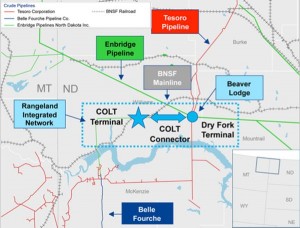
Inergy Midstream COLT Terminal Map

Rangeland Energy is being acquired by Inergy Midstream for $425 million. Rangeland owns and operates the largest crude oil hub in North Dakota - the COLT Rail Facility & Hub. The COLT facility is located in Williams County, ND, and includes a rail loading termina, as well as related pipeline and storage assets. All employees in the state will be offered jobs with Inergy.

"This is an exciting day for both companies. It`s also a great day for the crude oil industry in the Bakken, which will be well served by Inergy`s dynamic new presence in the play," said Rangeland CEO Chris Keene. "Inergy`s CEO, John Sherman, and the rest of his very seasoned leadership team have the experience and desire to serve our current customers with distinction and aggressively grow the business we`ve developed at COLT. We started with a piece of paper and a vision and now, just three years later, COLT is well positioned to be the premier crude oil terminal in the Bakken. I`m very proud of what the Rangeland team has accomplished in North Dakota in a very short period of time. The scope, quality and efficiency of the storage, rail and pipeline facilities we`ve put in place are unparalleled in the market."

COLT`s rail car loading facility is serviced by BNSF Railway. Storage and working capacity include:

  • 720,000 barrels of working storage
  • 120,000 barrels of tank storage
  • Access to 120,000 barrels of tank storage at the Dry Fork Terminal
  • Rail export capacity of 120,000 b/d
  • Pipeline capacity to move 75,000 b/d

Rangeland is based in Sugarland, TX, and its management will retain the company name to pursue other midstream developments. Rangeland is back by EnCap Flatrock Midstream - a private equity fund focused on midstream developments.

Kodiak Oil & Gas is Spending More & Lowering Guidance

Kodiak Oil and Gas Bakken Shale Map

Kodiak Oil & Gas lowered its production guidance for 2012 last week, but beat earning expectations today. The company expected to average 17,000-21,000 boe/d in 2012, but has lowered its production expectation to 15,500-17,500 boe/d. The company still reported a 300% increase in sales volumes year over year for Q3 and expects to hit its 2012 exit rate of more than 27,000 boe/d. My understanding is the company got a little ahead of itself with early projections and is being saved now by better realized prices. Better oil prices led the company to an earnings beat even though production volumes were lower than expected.

The company is also spending $165 million more than initially planned, while completing 66 net wells compared to 51 planned. The total capital budget was planned with $585 million in expenses, but 2012 spending is going to fall closer to $750 million. Almost $80 million of the outspend is due to non-operated areas being developed more quickly than expected. The other $85 million is due to higher costs than expected across the board. The company has spent about 20% more than expected on drilling and completing wells, salt water disposal facilities, and leasehold acquisitions.

The outspend isn't troubling considering the company is completing almost 30% more wells, but lower production guidance suggest wells aren't performing quite as strong nor are they coming online as quickly as the company expected. Kodiak expects to complete 26 net wells in the fourth quarter. That represents almost 40% of total activity for the year.

KOG's CEO commented:

"Kodiak continues to make progress in growing its production, as demonstrated by the 50% increase in average quarterly sales volumes for the third quarter of 2012 compared to the first quarter of 2012. With a large number of wells scheduled to be completed in the fourth quarter, we should see that same upward trajectory continue over the coming quarters. We completed 10 gross (9.3 net) wells during the month of October, and with two completion crews working steadily through year end, we expect to meet or exceed our stated 2012 exit rate guidance of 27,000 BOE/d."

Kodiak also expects well costs to fall below $10 million in the coming year. Current wells are running approximately $10.5 million to drill and complete, but pad drilling should allow the company to drill more wells with fewer rigs.

Whiting's Bakken Well Yields 2,800 boe/d in McKenzie County

Whiting Petroleum Bakken Shale Map

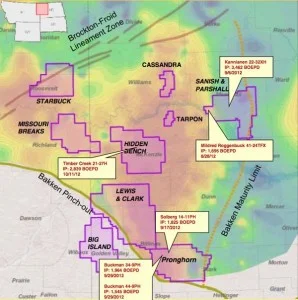
Whiting Petroleum's Hidden Bench area yielded a well that produced more than 2,800 boe/d in McKenzie County, ND. The well, the Timber Creek 21-27H, was one of many highlights in the company's third quarter conference call.

The company is now producing over 84,000 boe/d and 73% is attributable to the Rockies region, with more than 60% attributable to the Bakken. Considering only development since 2009, Whiting has been the largest Bakken and Three Fork producer in North Dakota over the past 12 months.

James Volker commented:

"We are generating exceptional results from our Three Forks drilling operations, as we continue development of our Sanish Field. Highlighting recent results was the completion of the Mildred Roggenbuck 41-24TFX well. This cross-unit well was drilled on the western side of the field and was completed flowing 1,695 boe/d.

At our Pronghorn prospect, we show a sampling of our typical strong well results. The Solberg 14-11PH flowed 1,825 boe/d. Two pad wells, the Buckman 34-9PH and the Buckman 44-9PH, flowed 1,964 boe/d and 1,545 boe/d, respectively. All 3 wells were completed in the Pronghorn Sand."

The company is also targeting the Red River formation at the Big Island Prospect. Over 500 vertical well locations have been identified using 3-D seismic. Wells are expected to yield 200,000-300,000 boe EURs at a cost of $3-3.5 million. The most recent completion flowed at over 300 boe/d from the upper Red River D zone. An additional horizontal test well in the lower Red River D is planned for 2013.

As 2013 approaches, expect Whiting to begin discussing operational efficiency in more detail. The company's Sanish rigs are drilling 15 wells per year, while the rest of the company's rigs are drilling closer to 10 wells per year. If wells per rig grows to 15 outside of the Sanish area, expect Whiting to realize significant operational savings.

Whiting's Bakken Midstream Assets Grow

Whiting also continues to expand on the ground in North Dakota.

  • A Watford City office is 90% complete
  • Robinson Lake Gas Plant's inlet gas rate increased 10% to 69 mmcfd
  • Belfield Gas Plant reached a record rate of 15 mmcfd in July
  • Two new gas plant projects were initiated in the quarter
  • Belfield Oil Terminal will be in service late November
  • Volumes in the Belfield Gathering System increased to 7,000 b/d in Q3

Halcon - Petro Hunt Bakken Deal Announced for $1.45 Billion

Halcon Resources Bakken Acreage Map

Halcon Resouces is acquiring Petro-Hunt's Bakkken assets for $1.45 billion ($700 million cash and $750 million in equity). Halcon will receive 10,500 boe/d of production and 81,000 net acres spread across Dunn, McKenzie, Mountrail, and Williams counties in North Dakota. The acreage is less than 40% developed and includes just over 42,000 net acres are located in the Fort Berthold area and just over 38,000 acres are located in the Marmon area.

Proved reserves are estimated 42.4 mmboe, with total resource potential that Halcon believes is more than 100 mmboe. Approximately 88% of reserves and production are crude oil.

After the deal, Petro-Hunt will remain one of the largest acreage holders in the basin, with more than 600,000 acres of leasehold. The company will also retain production of more than 24,000 boe/d.

Bruce Hunt of Petro-Hunt commented:

"We are pleased to become a significant Halcon shareholder through this transaction. The track record of Halcon's management team speaks for itself and we are confident they will do a great job of developing these solid assets.

Halcon's CEO commented:

"This acquisition is immediately accretive on all measures and is consistent with our strategy of building an oil company with a multi-year drilling inventory in liquids-rich basins. The assets we are acquiring are located in what is arguably the most attractive oil producing basin in the lower 48, on a risk adjusted basis..."

Halcon's Williston Basin Assets Expand

Halcon Resources Bakken Acreage Pre-PetroHunt

Halcon now has more than 135,000 net acres prospective for the Bakken in the Williston Basin. The company recently provide an operational update on its Bakken assets and disclosed the company was targeting a position of 125,000+ acres. This deal puts them over that threshold, so I don't expect additional transactions of this magnitude any time soon. 95% of the acreage acquired will be operated by Halcon.

Halcon had three rigs running in the area and Petro-Hunt hds five rigs running the properties sold. The assumption all five rigs won't come with the acreage is fair, but don't be surprised if you see Halcon ramp up to 5 rigs or more going forward.

Halcon also outlined several areas it sees opportunity for improvement and value creation:

  • Reduce drilling days with pad drilling
  • Lower completion costs by lower frac fluid volumes
  • More effective completions
  • Install gas and oil gathering systems
  • Utilze Halcon on salt water disposal facilities

Bakken Refinery on Fort Berthold Reservation Gets Interior's Approval

Fort Berthold Indian Reservation Map

A proposed Bakken refinery on the Fort Berthold Indian Reservation has been approved by the department of interior. The refinery will be the first built on U.S. soil in over 30 years. Several major refinery expansions have been undertaken by Marathon, Exxon, and others in the past decade, but difficult permitting has made new build refineries a scarce sight. The 13,000 barrel per day Bakken refinery will be small in comparison to the super refineries that process more than 500,000 b/d, but it will be a significant economic development for North Dakota.

Secretary Salazar commented - [blockquote type="blockquote_quotes" align="left"]By working with the Mandan, Hidatsa and Arikara people to place this land into trust status, we are supporting infrastructure that will help bring American oil and gas to market while promoting Tribal economic development and self-determination regarding land and resource use.[/blockquote]"By working with the Mandan, Hidatsa and Arikara people to place this land into trust status, we are supporting infrastructure that will help bring American oil and gas to market while promoting Tribal economic development and self-determination regarding land and resource use."

The MHA National Clean Fuels Refinery will be another Bakken job engine in North Dakota. As many as 1,000 jobs will be created during construction and 140 permanent operational jobs will continue once the Bakken refinery is brought online.

The Bakken refinery is being designed with capacity of 13,000 b/d and will refine local crude into diesel, propane, and naptha products. The proposed site will be contributed to a trust by the MHA Nation for development. The three tribes asked the Interior`s Bureau of Indian Affairs to accept a 469-acre piece of property into trust. The proposed refinery will use ~190 acres and the remaining acreage will be used for the production of feed for the Tribes` buffalo herd.

Additional federal permitting will be handled by the U.S. Army Corps of Engineers, EPA and OSHA. The Bureau of Indian Affairs and the EPA led the drafting of the Environmental Impact Statement that was issued in 2009.

The EPA issued a National Pollution Discharge Elimination System permit for the refinery in August 2011, a step under the Clean Water Act that details required conditions and limitations for the proposed refinery`s operations. A thirty-day notice of the Department`s decision to acquire the land in trust is being published in the Federal Register.