Bakken Oil Production Accounts for More Than 10% of U.S. Supply

ND Bakken Production 2011-072012

Bakken oil production from North Dakota surpassed 600,000 b/d in July of 2012. That's more than the country's number three oil producing state, California, and more than 10% of U.S. supply when you add Montana volumes.

The Montana and North Dakota Bakken surpassed 600,000 b/d sometime in the March-April timeframe and ND has continued to march on to new heights in July and August. The entire play is likely approaching three-quarters of a million barrels of oil per day. New rail facilities are allowing operators to bypass lower prices in Cushing, OK, for the better Gulf Coast market.

Over 2,200 wells have been brought online since the beginning of 2011 and more are expected as more than 200 rigs continue working the region. As discussed in a recent article, North Dakota Oil Production Could Jump to 2 Million Barrels Per Day Bakken production is expected to continue climbing at current oil price expectations.
Bakken Shale Waterfloods Better Understood in Early 2013 - EOG

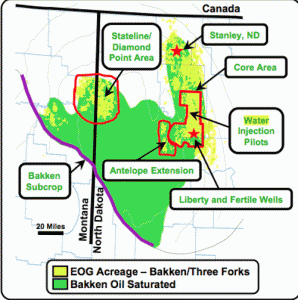
EOG Resources Bakken Shale Map

Bakken Shale waterfloods could be proven (or not) by late 2012 and you can expect to hear more from EOG in early 2013. EOG Resources' CEO has been open about additional recoveries being a major growth driver for the company going forward. The company highlights three areas when discussing horizontal oil production growth. The first bullet is where the company expects the most.

  1. Improving recovery factors - More dense well spacing and secondary recovery
  2. Explore for new horizontal liquids prospects in North America
  3. Indentify international horizontal oil opportunities with limited capital exposure

Bakken Secondary Recovery

EOG commenced secondary recovery pilots in mid-April of 2012 and expects to have a good understanding of the reservoirs response to water at year-end. Mr. Papa commented:

"We should have enough results to reach a conclusion. We should see or not see waterflood response by year-end 2012 or 2013......From the results of lab testing on cores, we feel pretty good at least from a labratory perspective. 2013 will be when we have an answer."

The company does not think water injection will be most effective in the Eagle Ford Shale. Expect to see dry gas injection tested for secondary recovery in the Eagle Ford in late 2013.

Statoil Bakken Crude Moving by Rail - Leasing 1,000+ Railroad Cars

Statoil's crude production from the Bakken is gaining additional capacity out of the region. The company plans to lease 1,000+ railroad cars to help alleviate transportation bottlenecks. The number of railcars leased will give the company capacity to move up to 45,000 b/d. That's more than Statoil produces, but the railroad cars can act as a form of storage as well. With railroad cars, the company has the option to sell crude in Canada, the East Coast, or the Gulf Coast. With discounts that stretch as high as $20 per barrel locally, it's easy to rationalize making this investment. Pipeline capacity constraints plague North Dakota and Montana because local demand is far outstripped by supply. Many operators are finding the Gulf Coast market offers the best price realizations (Louisiana Light Sweet Prices). WTI is largely being bypassed for other demand centers. Cushing, where WTI is priced, is addressing its own problems, so Canada and the coasts are better destinations.

Nowhere is the challenge more apparent than in North Dakota, which this year unseated Alaska as the country's second-largest oil-producing state. In May the state produced 639,000 barrels per day, or about 10% of the oil produced in the U.S., up from 364,000 barrels per day in May 2011, according to the U.S. Energy Information Administration.

Read the full story at wsj.com

QEP - Helis Bakken Deal Agreed for 27,600 Acres for $1.3 Billion

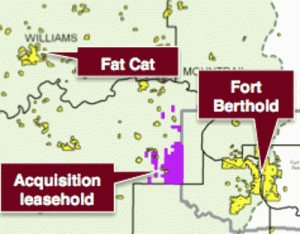
QEP Bakken Acquisition Aug 2012

QEP Resources added Bakken acreage for $1.3 billion. The company acquired 27,600 net acres that have production of 10,500 boe/d. Net proved and probable reserves add up to more than 125 million barrels of oil equivalent.

Reserves are 81% oil, 9% NGLs, and 10% natural gas. The company's average net revenue interest is 80% and the company will operate approximately 90% of the acreage acquired.

Most of the assets being acquired were owned by Black Hills E&P and Helis Oil & Gas.

QEP disclosed the following:

  • The properties are prospective for both the Bakken and Three Forks
  • There 72 gross (29 net) developed locations and 301 gross (146 net) undeveloped locations
  • Future developed capital is estimated at $1.59 billion
  • QEP Resources now has 118,000 net Bakken acres.

"The Acquisition will add a new contiguous block of QEP-operated acreage in a localized 'sweet spot' for both the Bakken and Three Forks formations, as evidenced by above average well performance and EURs from wells drilled to-date in both reservoirs," said Chuck Stanley, Chairman, President and CEO of QEP. "To drive operational efficiency, we have historically targeted the best rock in contiguous operated acreage blocks in the basins in which we operate. The Acquisition meets our criteria perfectly. Further, the Acquisition gives us a greater degree of operational flexibility in allocating rigs and personnel on our various assets in North Dakota. The Acquisition will allow our talented team of drilling and completion specialists to achieve the scale necessary to improve capital and operating efficiencies and drive down costs. We expect the growth potential of these assets to have a significant impact on our overall production, and more specifically on our crude oil production," Stanley added.

North Dakota Oil Production Could Jump to 2 Million Barrels Per Day

ND Pump Jack Photo
ND Oil Pump Jack

North Dakota oil production could surpass a whopping 2 Million barrels of oil per day by 2025. North Dakota is now the number two oil producing state in the country trailing Texas. That's the potential pegged in a recent Bentek study.

For those that were around back in 2000, production in all of ND was less than 90,000 b/d of oil and the average well produced just 27 b/d. Even in 2005, production in still less than 100,000 b/d. Oh, what a few years can change. Today, the same area is producing more than 600,000 b/d and the average well is producing more than double what it was in 2000 (>65 b/d). Total production has increased more than six-fold in a twelve year period and many expect it will double again. The Bentek example is likely a high case, but possible nonetheless. I wouldn't say anything is impossible based on what we've learn over the last decade.

Read more about the Bentek prediction at fuelfix.com